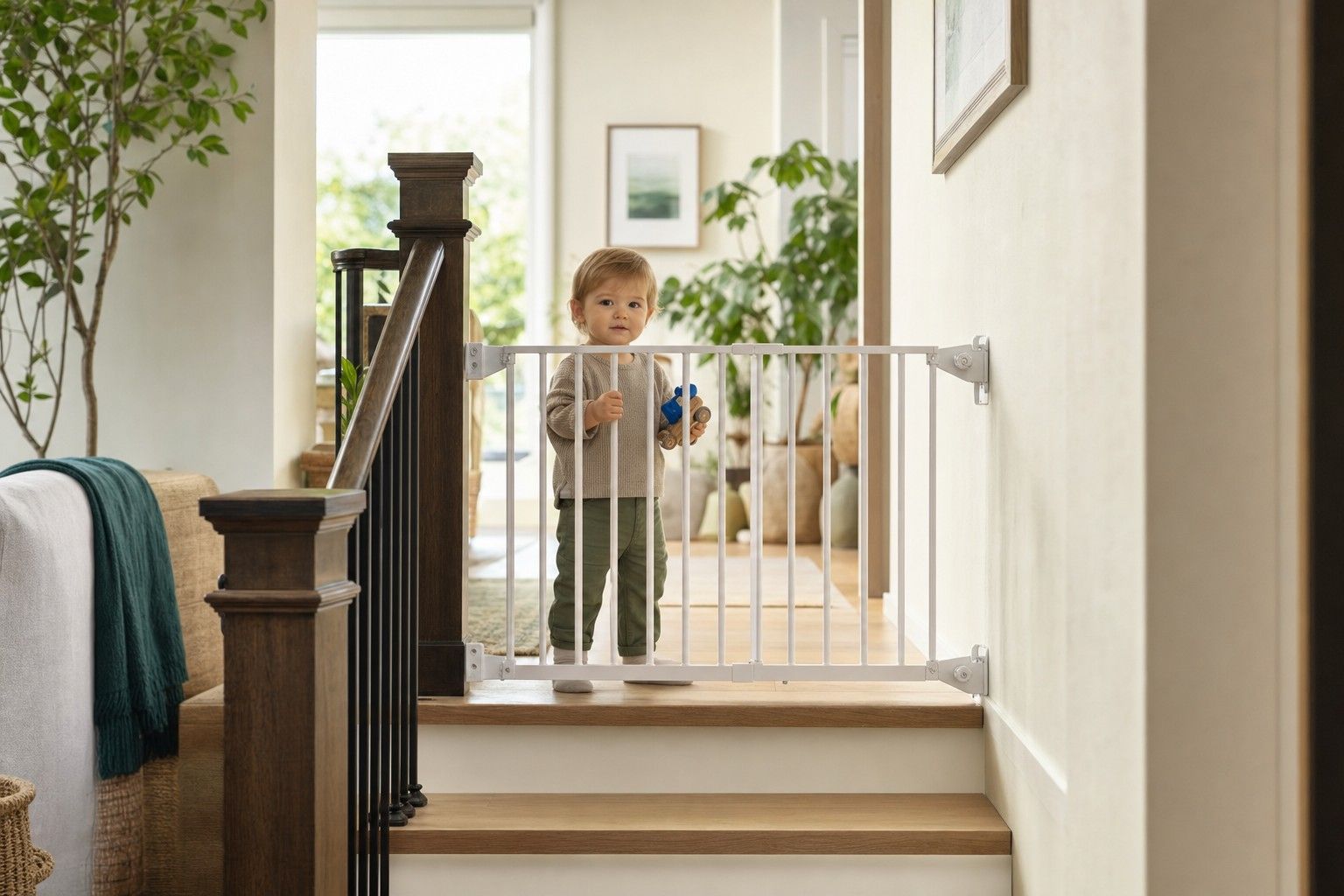
Childproof gates for stairs belong at both the top and the bottom of every staircase, and the gate at the top must be hardware-mounted, which means screwed into a stud, a post or masonry. When one side of the opening is a banister, an adapter kit lets you mount a baby gate for stairs with a banister without cutting into the railing. The details below cover top versus bottom, banister kits, round or uneven newel posts, stone walls and wide openings.
Childproof gates for stairs: top versus bottom
The American Academy of Pediatrics (AAP) advises installing safety gates at both the top and the bottom of stairs once your child is learning to crawl and walk. The two gates do different jobs. The bottom gate stops a crawler from starting the climb. The top gate stops a fall down the whole flight, which makes it the one to get right.
For the top of stairs, the U.S. Consumer Product Safety Commission (CPSC) says to use only gates that screw to the wall. A pressure-mounted gate holds by pushing outward against the two sides of the opening. That works in a doorway, but at the top of a staircase a gate that a child leans on, rattles or pushes loose opens straight onto the steps.
A few more details matter at the top of the stairs. Check each one before the gate goes in.
- The gate should swing toward the landing and never out over the stairs. If the gate has a swing stop, set it so the gate can only open one way.
- Choose a gate without a bar across the floor. An adult carrying a baby down the stairs can catch a foot on it.
- Make sure the latch closes on its own or with one firm push, so a gate left half open by a busy adult gets noticed.
At the bottom, a pressure gate is sometimes acceptable when the manufacturer allows it. Hardware-mounting the bottom gate too keeps it from creeping loose as a toddler leans on it daily, and it lets both gates match.
Gate types to avoid
Some gates are still sold or handed down that shouldn’t be used on stairs at all. The AAP advises against accordion-style gates, which can trap a child’s arm or neck, and recommends gates firmly mounted to the home’s studs.
The CPSC adds two more rules worth following. Replace older gates that have “V” shapes in their design, and never use a pet gate as a child safety gate, however sturdy it looks.
New gates sold in the U.S. must meet the CPSC’s mandatory safety standard for gates and enclosures, published as 16 CFR part 1239, which incorporates the ASTM F1004 standard. A secondhand gate with no label or instructions is hard to judge, so it is worth replacing.
How a baby gate mounts to a banister
Most staircases in Los Angeles homes have a wall on one side and a railing on the other. The wall side is easy if there’s a stud in the right place. The banister side is where most gate installations get complicated.
A newel post is rarely flat. It may be round, square with a chamfered edge, tapered or carved. Gate hinges and latches need a flat, solid surface, and screwing straight into a finished post leaves permanent holes in wood you may want to keep.
Banister adapter kits solve this. They wrap around the newel post or the end of the handrail with straps or clamps and create a flat mounting board that the gate screws into. Common types include:
- Strap-on kits that cinch around a round or square post.
- Clamp kits that grip a post from both sides.
- Y-spindle mounts that attach to two balusters when there is no newel post at the top.
- Dual-banister kits for stairs with railings on both sides and no wall.
Whatever the kit, the test is the same. Pull and push on the closed gate firmly. Nothing should twist, slide or flex at the mount.
Round, tapered or uneven newel posts
Round posts are the most common challenge. A strap kit can hold on a round post, but it needs enough contact area, and on a very thick or very thin post it may need spacers or a second strap to stop rotation.
Tapered and turned posts change diameter along their height. The trick is to mount at a section where the post stays close to the same width, then shim the kit so the gate hangs plumb. If the post flares at the base, the bottom of the kit may need a spacer block.
Some staircases put the newel post back from the edge of the top step, or angle it toward the landing. In those cases an extension or angle-mount kit brings the gate’s hinge in line with the opening. Without it, a gate can end up with a gap a toddler could squeeze through.
Stone walls, plaster and wide openings
Stone and brick
Stone and brick walls appear around fireplaces, in entry halls and on Spanish Revival stairways. They need masonry anchors chosen for the material, set into solid stone or brick rather than crumbling mortar. When the wall is a finish you don’t want to drill, a wood post fastened at a nearby stud, or a mount on the banister side, can carry most of the load.
Lath and plaster
Older homes often have plaster over wood lath. Stud finders struggle with it, and careless drilling can crack the plaster around the hole. Finding the stud with small test holes in a spot that the gate will cover keeps the repair hidden.
Wide or odd-shaped openings
Lofts, open landings and split-level homes sometimes have openings wider than a standard gate. Extra-wide hardware gates and multi-panel configurable gates can span them, and some openings need a fixed post installed partway across. Angled walls call for gates with pivoting mounts so each panel sits square to its surface.
Stair gate checklist before you buy
- Measure the opening at the height where the gate will mount, on both sides.
- Note what each side is made of: drywall over a stud, plaster, stone, brick, a round post, a square post or glass.
- Choose a hardware-mounted gate for every top-of-stairs location.
- Confirm the gate swings away from the stairs and has no floor bar at the top.
- Skip accordion gates, older “V” gates and pet gates.
- Buy the gate new, with its full instructions, from a seller you trust.
- Pick a finish that works with your railing, since a gate on a banister stays in view for a year or more.
- Check the gaps between balusters while you are there. If a toddler could slip through or climb them, the railing needs guards too.
Stair gates in Los Angeles homes
Housing here mixes styles in ways that make stair gates harder than the box suggests. Spanish Revival homes pair wrought-iron railings with plaster or stone walls. Craftsman homes tend to have heavy wood newel posts that owners don’t want drilled. Modern hillside homes often use glass panels, cable railings or open-riser stairs, which need clamp mounts or railing guards rather than standard screws.
Multi-level homes also simply have more gates. A house with a split-level entry, a main stair and stairs down to a family room can need several gates, and each one may mount differently. Measuring all of them on one visit keeps the finishes consistent.
When to call a professional
Many parents can put up a pressure gate in a hallway on their own. The top of a staircase with a banister is where hardware choice, mounting height and swing direction all matter at once, and where a mistake has the biggest consequence.
Our baby gate installation service fits hardware-mounted gates to banisters, round posts, stone and plaster, and matches finishes to your railing. If the balusters or a balcony edge have gaps a child could get through, we add clear stair railing guards in the same visit.
For a full-house plan, start with a home safety assessment. Renting and can’t drill? Our guide to renter-friendly babyproofing covers options that come out cleanly.
Sources
- Childproofing Your Home: Several Safety Devices to Help Protect Your Children from Home Hazards, U.S. Consumer Product Safety Commission
- Home Safety: Tips for Families With Young Children, HealthyChildren.org (American Academy of Pediatrics)
- Movement Milestones in Babies 8 to 12 Months Old, HealthyChildren.org (American Academy of Pediatrics)
- Gates and Enclosures Business Guidance, U.S. Consumer Product Safety Commission