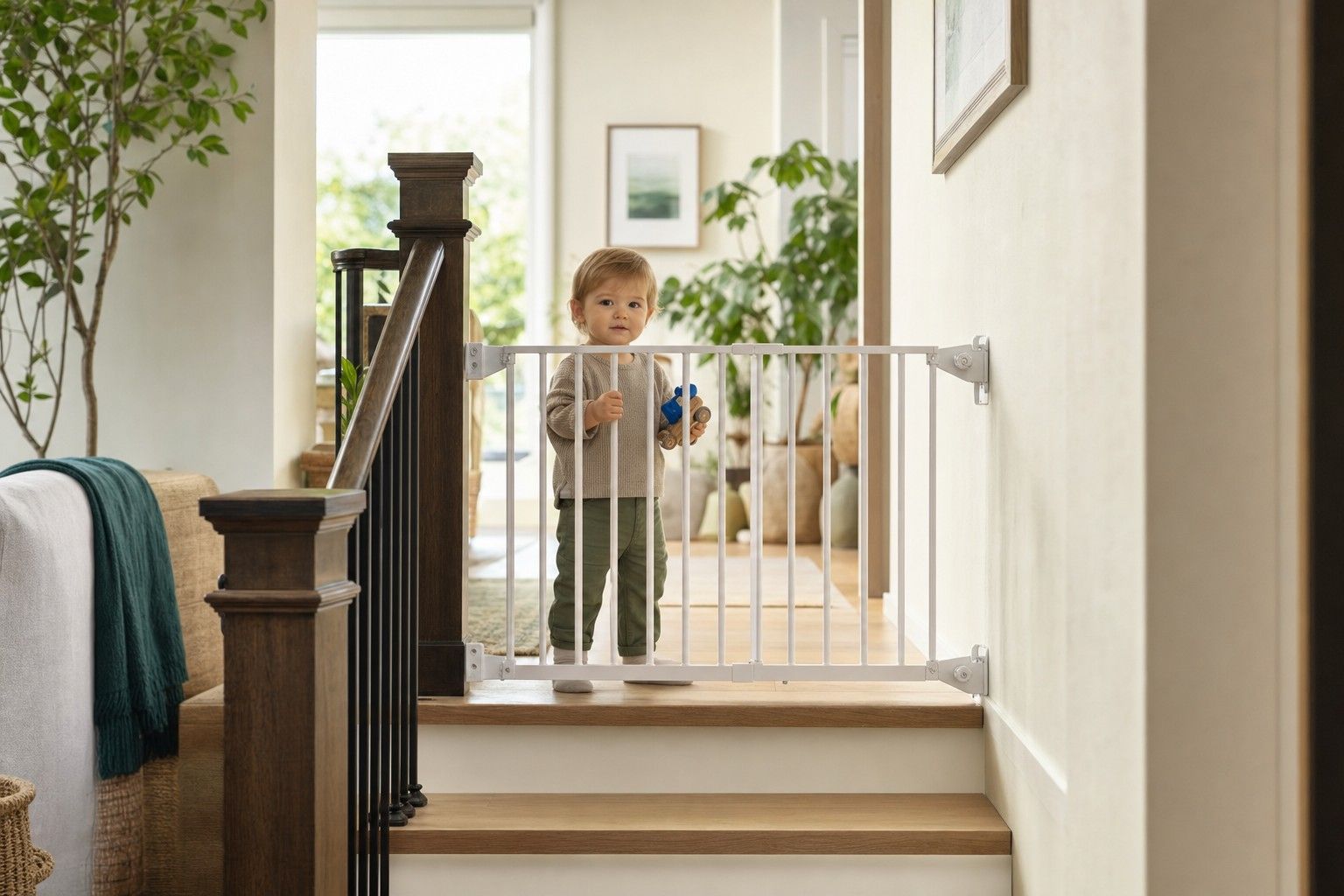
Baby gate installation means choosing a gate that fits the exact opening and the wall around it, then mounting it so a determined toddler can’t push it loose. Every gate we install at the top of a staircase is hardware-mounted, screwed into studs, masonry or a banister adapter, and never held by pressure alone. The usual triggers are a baby crawling toward the stairs, or a store-bought gate that won’t fit a banister, a wide opening or a tile wall.
A well-fitted gate is easy to live with. You open it with one hand while holding a baby on your hip, and we test that it latches on every close before we leave.
Why baby gate installation matters
Stairs are usually the first serious hazard a crawling baby finds, and a gate is what keeps the two apart. For the top of the stairs, the U.S. Consumer Product Safety Commission (CPSC) says to use only gates that screw to the wall. A pressure-mounted gate stays put through friction against the wall, and a toddler who leans, rattles or climbs on it every day can shift it a little at a time until it gives.
Mounting is where many gates fail. Screws driven into drywall alone can pull out under the kind of force a toddler applies, so a properly installed gate goes into a stud, solid blocking, masonry or a purpose-made adapter. The gate’s swing matters too. At the top of a flight, the door should open over the landing and never out over the steps.
Older gates deserve a second look. The CPSC recommends replacing older gates with V-shaped openings large enough to trap a child’s head and neck, and it says pet gates should never stand in for child safety gates. Gates sold in the United States today must meet the federal safety standard for gates and enclosures (16 CFR part 1239), which is a good baseline when we pick hardware for your home.
What we install
- Hardware-mounted top-of-stair gates, fastened into framing with a swing stop so the gate opens only toward the landing.
- Banister adapter kits that clamp around a newel post or between balusters, giving the gate a mounting surface without drilling into finished woodwork.
- Configurable panel gates for wide or irregular openings, such as open kitchens, angled landings and spaces where a gate has to meet a half-wall.
- Retractable mesh gates that roll into a slim housing at one side, a good fit for hallways and modern interiors where a gate should vanish when open. We use them at the top of stairs only where the manufacturer rates them for it.
- Gates for stone, tile and brick, mounted with masonry anchors or to a wood post fixed beside the opening.
- Custom configurations: two gates on a split landing, a gate that wraps around a kitchen peninsula, or a gate at a mid-flight landing in a multi-level house.
- Bottom-of-stair and room-to-room gates, where pressure mounting is sometimes acceptable and saves a few holes.
How installation works
We start by measuring every opening at the top and the bottom, because walls and banisters are rarely perfectly plumb. A gap that is 36 inches at the floor can be 37 at waist height, and a gate that fits one measurement can rattle at the other.
Next we find what’s behind the surface. A stud finder tells us where the framing is, and on older homes we check whether the walls are drywall or plaster over lath. For banisters, we check whether the newel post is solid wood, hollow, or metal, and whether it is firmly attached to the stairs. A wobbly post gets flagged before any gate goes on it.
Then we choose the gate and the mounting method together. Sometimes that means a standard hardware-mounted gate. Sometimes it takes a banister kit on one side and wall hardware on the other, or a wood mounting board to bridge a baseboard or a stone edge.
Installation itself includes a pull test on every mount, a check that the latch catches each time the gate swings shut, and a walk-through with each adult who will use it. Nannies and grandparents get the same quick lesson, since a gate only helps when everyone closes it. Our guide on baby gates for stairs with banisters covers the common banister setups in more detail.
Design-friendly and renter-friendly options
A gate is often the most visible piece of childproofing in a house, so finish matters. We source wood gates that can sit next to oak or walnut treads, slim metal gates in matte black or white, and gates with clear acrylic panels for homes where sightlines are part of the design. Retractable mesh gates leave almost nothing visible when they’re open.
For renters, banister adapters avoid holes in the banister entirely, and a wall-side mount into a stud leaves two or three small holes that patch easily before move-out. When you’d rather not drill a tile or stone surround, a mounting board fixed to the nearest wood trim is often an option. We’ll tell you which approach your landlord is likely to care about.
Baby gates in Los Angeles homes
Los Angeles staircases come in every style, and each one changes how a gate gets mounted. In Spanish Revival homes from the 1920s and 1930s, stairs are often tiled, walls are plaster over lath, and railings are wrought iron. Those houses need masonry anchors, careful drilling and adapters that grip iron balusters.
Craftsman houses, common in Pasadena and older Los Angeles neighborhoods, tend to have thick wood banisters and newel posts that owners don’t want to drill. Banister kits were made for them. Mid-century and contemporary homes bring open floor plans, floating stairs and openings much wider than a standard gate, which is where panel gates earn their keep.
Hillside homes are their own category. A house in the Hollywood Hills may have three or four short flights, a landing that opens onto a deck and railings with wide gaps. Those homes usually need gates paired with stair railing guards so the child can’t go through the railing beside the gate.
Earthquakes are a consideration as well. A gate mounted into framing stays put through ordinary shaking, but after a strong quake it is worth checking every gate’s screws and latch, the same way you’d check a shelf.
Related services
Most gates are planned during a home safety assessment, where we map every stair, doorway and opening in one visit. Homes with open railings often pair gates with stair railing guards, and households with a dog or cat may want gates that include a small pet door, which we cover under pet-proofing.