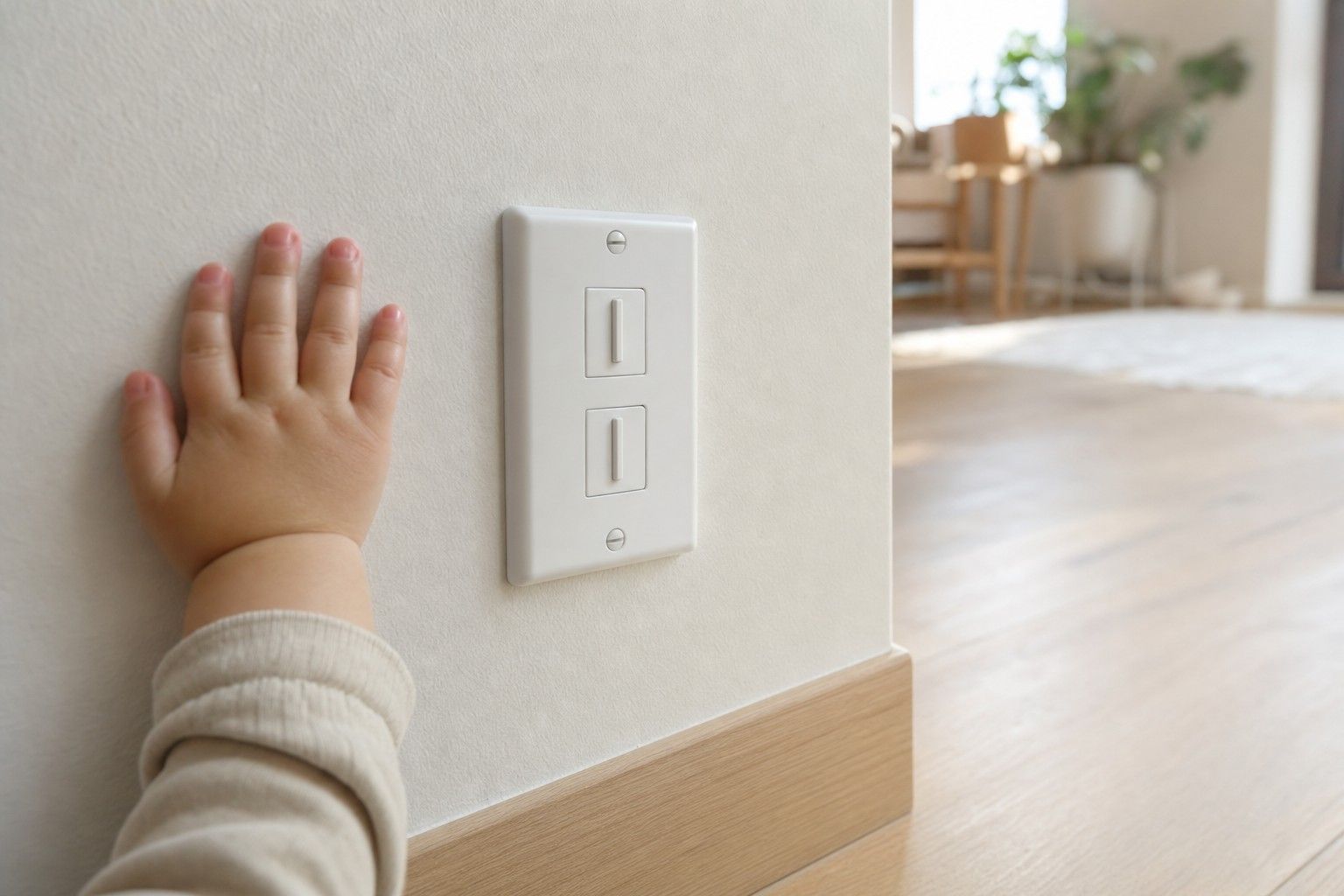
Outlet and electrical childproofing keeps a crawling baby’s fingers, keys and hairpins out of live receptacles, and keeps cords out of mouths and hands. We replace loose plug-in caps with self-closing sliding outlet covers, enclose power strips and outlets that are always in use, and route or conceal cords behind furniture and along baseboards. The best time is before the baby starts crawling, since outlets sit right at floor level.
It is one of the quickest parts of childproofing a home, and one of the most visible if done badly. Good covers match your faceplates and stay on the wall.
Why outlet and electrical safety matters
Babies explore with their fingers and mouths, and outlets near the floor are among the first things they find. The U.S. Consumer Product Safety Commission (CPSC) advises using outlet protectors that children can’t easily remove and that are large enough that a child can’t choke on them. Small plastic plug-in caps can fall short on both counts. They come out whenever someone needs the outlet, and a loose cap on the carpet is small enough to end up in a baby’s mouth.
Cords are a separate hazard. A lamp cord or a phone charger dangling off a nightstand is a handle, and a toddler who pulls it can bring the lamp or a hot appliance down. Extension cords and power strips on the floor put many live openings in one place.
The CPSC also recommends that when receptacles are replaced, the new ones be tamper-resistant. The National Electrical Code has required tamper-resistant receptacles in new homes since its 2008 edition, but older houses usually have standard ones. Replacing receptacles is electrical work for a licensed electrician, and we don’t do it. We install the covers and cord solutions that work with the receptacles you have.
What we install
- Self-closing sliding outlet covers that replace the existing faceplate. When a plug comes out, a spring slides the cover shut over the slots.
- Covers for Decora-style and GFCI outlets, which need different plates from standard duplex outlets.
- Box-style covers for outlets that always have something plugged in, behind the TV, under a desk, beside the crib for a sound machine.
- Power strip covers that enclose the whole strip with only the cords exiting.
- Cord shorteners and wraps that take up extra length on lamps, chargers and baby monitors.
- Paintable cord raceways along baseboards and walls, so cords cross a room without hanging loose.
- Light switch guards for switches a toddler shouldn’t flip, such as the garbage disposal switch beside the sink.
- Floor outlet covers for open-plan living rooms where outlets sit in the floor.
How installation works
A crawling baby sees each room from the floor, and that’s where our survey starts. We count outlets, note their style (standard duplex, Decora or GFCI), and mark which ones are always in use. Kitchens and bathrooms get attention for outlets near counters, since a child standing on a stool can reach them.
Installing a sliding cover means removing the faceplate screw and fitting the new plate in its place. No wiring is touched. We check that each plate sits flat, that plugs go in and come out smoothly for adults, and that the slider snaps shut on its own.
For cords, we work device by device. Lamps get moved so the cord runs behind furniture, and chargers get a home on a surface rather than a cord hanging over an edge.
Baby monitors need special care. The CPSC advises keeping baby monitor cords at least three feet from any part of the crib, so we position the monitor and fasten its cord to meet that distance.
If we notice something that needs an electrician, such as a scorched faceplate, a loose receptacle, an outlet that’s warm to the touch or two-prong outlets throughout, we point it out and recommend that a licensed electrician take a look. Those are wiring questions, and covers can’t answer them.
Design-friendly and renter-friendly options
Sliding outlet covers come in common faceplate colors such as white, ivory, light almond and black, in standard and Decora styles, so they can match the existing faceplates in each room. Many look like ordinary faceplates until you notice the slider. Raceways are paintable and disappear into a wall painted the same color.
For renters, sliding covers are an easy fit, since the original faceplates go in a labeled bag and swap back before you move. Box covers and power strip covers attach with the faceplate screw or sit on the floor. Raceways use adhesive backing, which can lift paint when removed, so we place them low and behind furniture where possible. Our renter-friendly babyproofing guide covers more options like these.
Outlet safety in Los Angeles homes
Many older Los Angeles homes, from 1920s Spanish Revival houses to postwar ranch homes, were built with fewer outlets than families use today, so power strips and extension cords end up everywhere. Those homes often have two-prong ungrounded outlets as well, which is worth raising with a licensed electrician. Our job there is to tame the strips and cords so a toddler can’t reach them.
Homes built or rewired in recent years usually have tamper-resistant receptacles already, often marked TR on the face. In those rooms, covers are optional, and the focus shifts to cords and the outlets that are always in use.
Outdoor outlets on patios and near pools are common across the city. Those need weather-resistant covers, and anything involving GFCI protection or new wiring belongs to an electrician. In high-rise condos with open floor plans, floor outlets in the living room are the ones a crawling baby finds first, and they get their own covers.
Related services
In kitchens and bathrooms, outlet work pairs with cabinet and door locks. Behind the TV, cord management pairs with furniture and TV anchoring. A home safety assessment counts every outlet and cord in the house, and our childproofing checklist shows where they fit in the order of things to do.