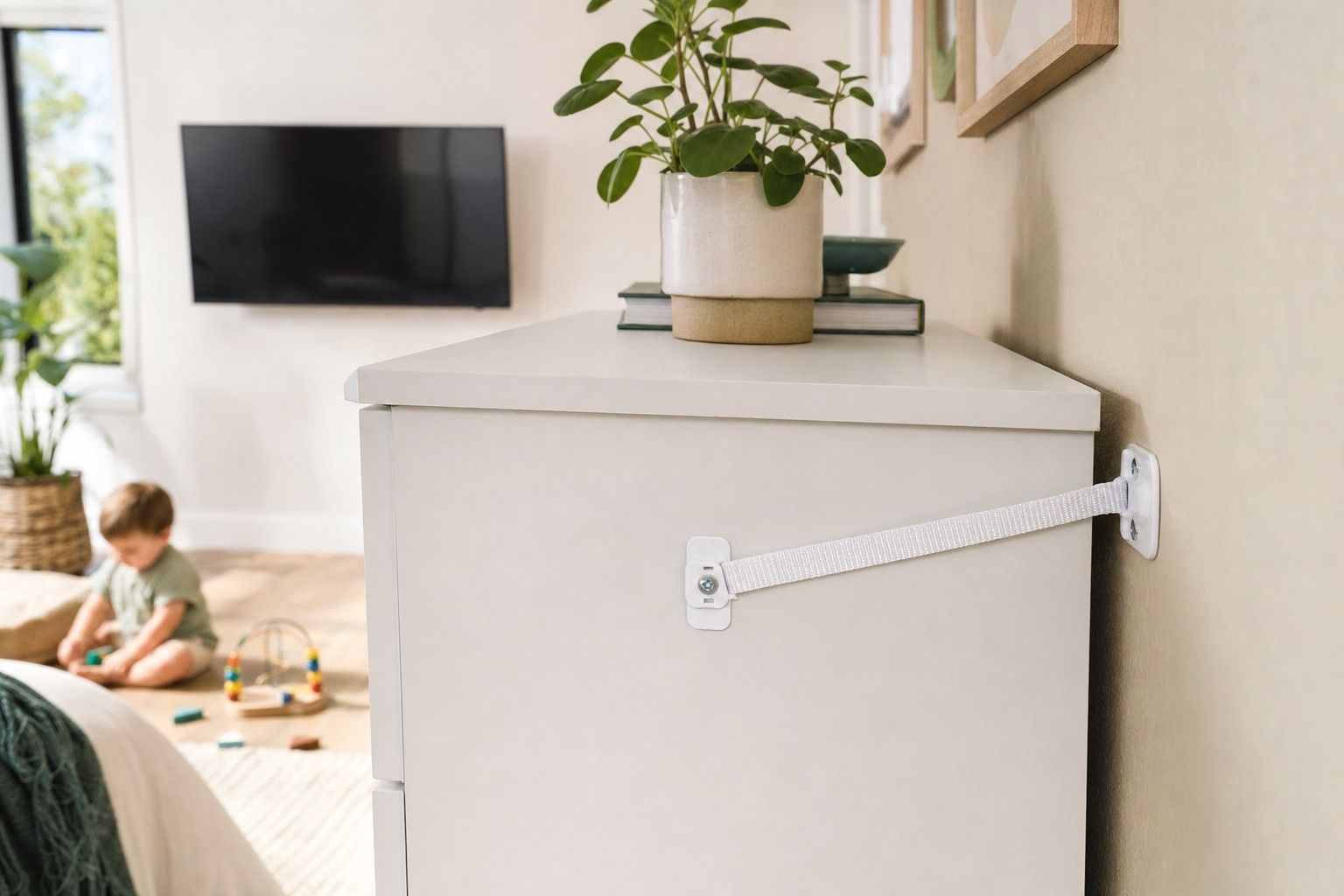
Furniture and TV anchoring fastens dressers, bookcases, armoires and televisions to the structure of the wall so they can’t tip onto a child who climbs, pulls or opens every drawer at once. We fasten into wood studs or masonry, never into drywall alone. In Los Angeles the same hardware does double duty, since a dresser that can’t tip toward a toddler also stays put in an earthquake.
Anchoring is one of the first jobs to do once a baby can pull up to standing. Each piece takes little time, and the hardware hides behind the furniture.
Why furniture and TV anchoring matters
The U.S. Consumer Product Safety Commission (CPSC) estimates that emergency departments treat an average of 17,800 tip-over injuries each year, and it warns that furniture, TVs and ranges can tip over and crush young children. Its advice is to anchor them to the floor or attach them to a wall. The usual scenarios are ordinary ones. A toddler uses open drawers as stairs, pulls on a shelf to stand, or reaches for a remote on top of a dresser that also holds a television.
Weight high up makes the problem worse. A TV placed on a dresser or a tall stand shifts the center of gravity forward and up, and a small pull is enough to start it moving. Bookcases are tall and shallow by design, which makes them easy to tip from the front.
Federal rules have improved new furniture. The STURDY Act, signed into law on December 29, 2022, led to a mandatory CPSC stability standard for clothing storage units such as dressers and chests, which took effect on September 1, 2023, for units made on or after that date.
Hand-me-downs, vintage pieces and anything older fall outside it, and so do bookcases, which the standard doesn’t cover. Our guide to the STURDY Act and dresser tip-overs explains the standard in more detail.
What we install
- Metal anti-tip brackets and steel cable kits for dressers, chests and armoires, attached to the piece’s frame at the top rear corners.
- Low-profile straps and L-brackets for bookcases, open shelving and étagères, placed so they disappear behind books.
- TV anti-tip straps that tie a television on a stand or console to the furniture or the wall.
- Wall mounts for flat-screen TVs, fastened into studs or masonry and set high enough that small hands can’t reach the screen.
- Anchors for tall storage in nurseries and playrooms, including changing tables, cubbies and toy shelves.
- Floor mirrors and leaning art, which get a hidden strap or a top bracket so they can’t slide and fall forward.
- A check of the kitchen range’s anti-tip bracket, which the CPSC recommends for ranges. If it’s missing or disengaged, we note it so the appliance installer can correct it.
How installation works
We begin with a survey of every tall or heavy piece in the house, not only the nursery. Kids explore everywhere, so the bookcase in the den and the dresser in the guest room count as much as the one beside the crib.
For each piece, we check two things: what the wall is made of and how the furniture is built. A stud scanner finds the framing behind drywall. Plaster over lath, brick and concrete each need their own approach. On the furniture side, we look for solid wood at the top rear, because a bracket screwed into a thin back panel will tear out before the piece stops moving.
We then fasten the bracket to the furniture, run a strap or cable to a second bracket in the wall stud, and pull it snug so the piece can’t lean forward. When baseboards push a dresser away from the wall, a spacer block keeps it from rocking. Then we test the piece by opening drawers and pulling on the top edge until we’re sure nothing moves.
TVs follow the same logic with a few extra steps. We locate the mounting points on the back of the set, confirm the bolt size, and tidy the cords so a toddler can’t use them to pull. Our guide on how to anchor furniture and TVs shows the common setups if you want to see the hardware before the visit.
Design-friendly and renter-friendly options
Most anchoring hardware ends up out of sight. Brackets go on the back of the piece, straps run behind it, and wall hardware sits low or high where the furniture hides it. For open shelving, we choose slim brackets in white, black or brass that read as part of the shelf. For wall-mounted TVs, we can recess cords behind the wall when a licensed electrician has added an outlet there, or run them through a paintable raceway.
Renters have good options. A stud-mounted bracket leaves one or two small screw holes that patch in minutes, and a steel cable kit can be unclipped from the wall when you move. We steer away from adhesive-only anchors for heavy pieces, because a strap is only as strong as what holds it to the wall.
Furniture and TV anchoring in Los Angeles homes
Earthquakes give anchoring extra weight here. According to the U.S. Geological Survey (USGS), the Los Angeles region has a 60 percent chance of a magnitude 6.7 earthquake within the next 30 years. The same straps that stop a toddler tip-over keep a dresser against the wall when the ground moves.
Wall construction varies a lot across the city. Prewar homes in neighborhoods like Hancock Park and Los Feliz often have plaster over lath, which cracks if drilled carelessly. Many Westside and Valley homes from the postwar decades have standard drywall over wood studs. High-rise condos often have concrete walls that call for masonry anchors.
Newer homes and remodels often feature built-ins, floating shelves and large wall-mounted TVs over fireplaces. Those still need checking, since a floating shelf depends entirely on what’s behind it and a TV above a mantel invites climbing. In a wildfire rebuild, we can mark stud locations or add blocking while walls are open, so anchors land exactly where the nursery furniture will go.
Related services
Anchoring pairs naturally with earthquake safety, which adds water heater strapping, cabinet latches and safer ways to hang art. Dresser drawers and kitchen cabinets often get latches in the same visit through our cabinet and door locks service. If you’re not sure where to start, a home safety assessment lists every piece that needs anchoring, room by room.