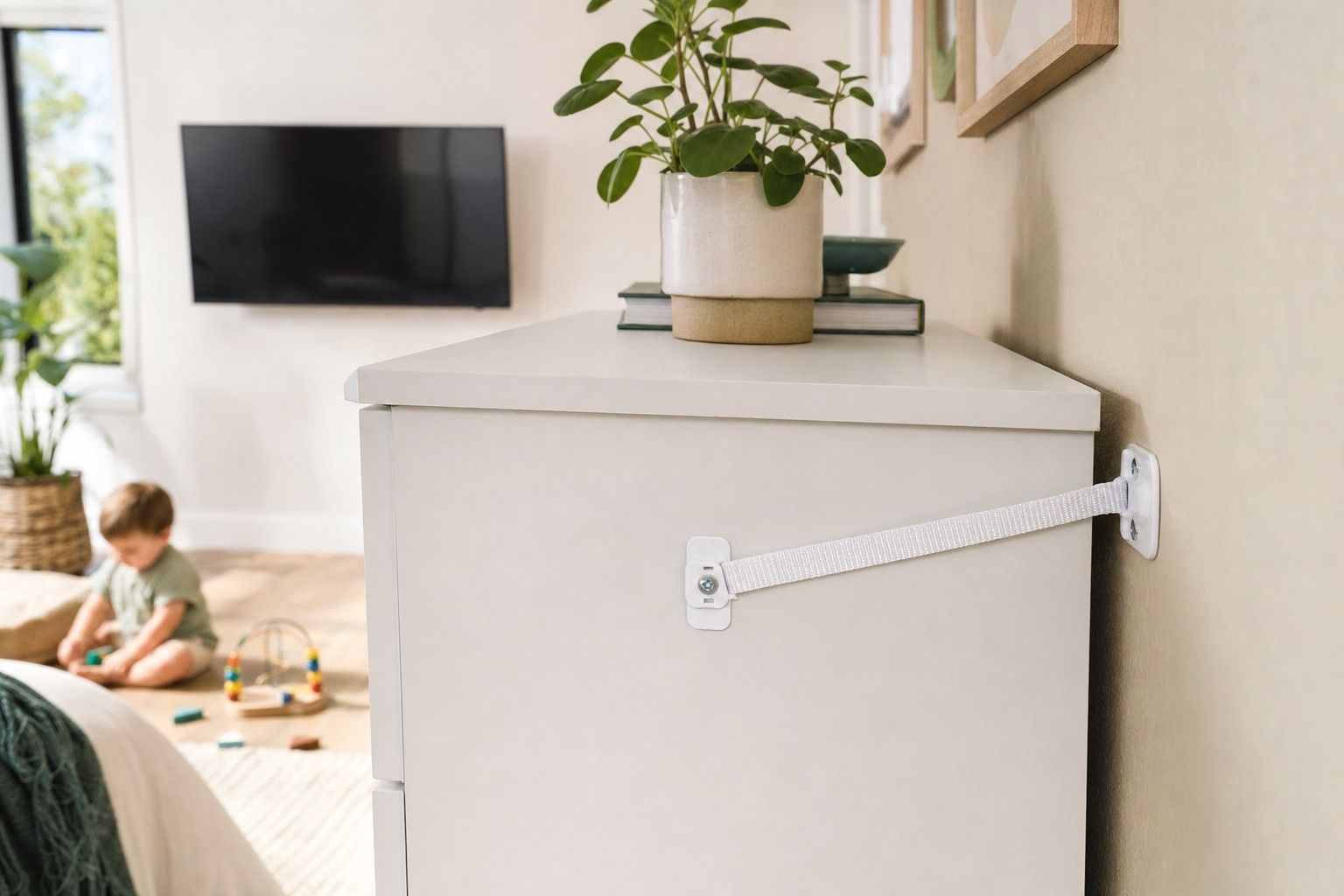
Furniture anchoring means fastening dressers, bookshelves, tall cabinets and TVs to wall studs or masonry with metal brackets and straps, so they can’t tip forward when a child climbs or pulls on them. In Los Angeles the same anchor does a second job, holding tall furniture against the wall when an earthquake shakes the house. Most homes with young children need anchors in the nursery, the bedrooms and the family room, plus a secure mount or strap for every TV.
Why furniture and TVs tip over
A dresser with its drawers pulled out works like a staircase to a toddler. Each open drawer moves the center of weight forward, and a child’s weight on the lowest drawer can be enough to tip the whole piece. TVs add the same problem from above, especially when they sit on a dresser or a narrow stand that was never designed to hold them.
The U.S. Consumer Product Safety Commission (CPSC) tracks these incidents. A CPSC report released in February 2024 estimated that about 17,800 people a year were treated in emergency departments for furniture, TV and appliance tip-over injuries from 2020 to 2022, and children under 18 suffered 44 percent of those injuries. Of the 217 tip-over deaths reported from 2013 through July 2023, 47 percent involved a television and 55 percent involved children between one and three years old.
The CPSC’s advice is to anchor TVs and furniture such as bookcases and dressers securely to the wall. It also suggests keeping toys and remotes off places where children might climb to reach them, and storing heavier items on lower shelves.
Which furniture to anchor
The CPSC’s Anchor It campaign recommends anchoring all furniture with drawers, doors and shelves. In practice, that list covers more pieces than most families expect.
- Dressers, chests of drawers and armoires in every bedroom.
- Bookshelves and bookcases, including low ones a child can climb.
- TVs and the stands or consoles under them.
- Tall cabinets, china hutches, bar cabinets and media units.
- Changing tables and nursery shelving.
- Cube storage and toy shelves taller than your child.
- Floor mirrors, leaning ladder shelves and tall floor lamps that a child can pull over.
- Stand-alone kitchen ranges, which use a dedicated anti-tip bracket at the floor.
Start with the nursery and the rooms where your child plays, then work outward. Garage shelving, pantry racks and wine storage matter more for earthquakes than for toddlers, though a curious three-year-old will find those too.
What the STURDY Act changed for new dressers
The federal STURDY Act led to a CPSC mandatory standard for clothing storage units, published as 16 CFR part 1261. It applies to units manufactured after September 1, 2023, adopts the ASTM F2057-23 stability standard, and requires an anti-tip device meeting ASTM F3096 to be packaged with the product. The rule covers stand-alone dressers, chests and armoires that are at least 27 inches tall, weigh at least 30 pounds and hold at least 3.2 cubic feet of enclosed storage.
That helps with new furniture, but it leaves out the vintage dresser, the hand-me-down bookcase and every piece made before the rule. Anchor those first. Our guide to the STURDY Act and dresser tip-overs covers the standard in more detail.
Plastic straps versus metal hardware
In January 2024 the CPSC announced a recall of millions of plastic tip-over restraint kits made by New Age Industries and sold by Alliance4Safety and 33 furniture companies, because the plastic zip tie can become brittle or break. If an older anchor kit in your home uses plastic ties, it is worth replacing. Metal L-brackets or braided steel cable straps fastened into studs are the sturdier long-term choice.
How to anchor a bookshelf to the wall, and other furniture
The Anchor It site walks through the basic steps for any piece. You attach one bracket to the wall, move the furniture close to the wall, attach the other bracket to the furniture, connect them with the strap and tighten it. Then tug on the furniture to check it holds.
The details decide whether that anchor will hold under a climbing toddler or a strong quake. Most of them depend on what is behind the wall.
Finding studs in drywall
A stud finder locates the wood framing behind drywall in most modern homes. Confirm the stud with a small test hole behind where the furniture will stand, then drive the screw well into the wood. Anchoring to drywall alone, even with plastic plugs, is much weaker, because the gypsum crumbles under a sudden pull.
On the furniture side, avoid the thin fiberboard back panel. Fasten the bracket to the top rail, a side panel or a solid frame member near the top of the piece, where a strap has the most leverage against tipping.
Lath and plaster, brick and concrete
Many older Los Angeles homes, including 1920s Spanish Revival and Craftsman houses, have plaster over wood lath. Electronic stud finders often read it poorly, so studs are found by measuring from corners and outlets and confirming with test holes. Drilling slowly with the right bit keeps the plaster from cracking around the screw.
Brick, stone and concrete need masonry anchors sized for the material. You’ll find these around fireplaces, in older garages and basements, and on concrete walls in high-rise condos. Many condo interiors also use metal studs, which call for different screws than wood framing.
TV anti-tip straps and wall mounts
A TV is heavy at the top and often sits on furniture that wasn’t built for it. There are two good ways to secure one.
- Wall mount. A mount screwed into studs holds the TV flat to the wall and takes it off any surface a child can climb. Route the cords inside the wall or in a cover so they can’t be pulled.
- TV anti-tip straps. For a TV on a stand, straps connect the mounting holes on the back of the TV to the wall or to the stand. Anchor the stand itself too, or the strap just pulls the stand over with the TV.
When anchoring isn’t possible, the CPSC suggests placing the TV on a sturdy, low base and pushing it as far back as it will go, with cable cords kept out of reach. A TV should never sit on top of a dresser in a child’s room.
How furniture anchoring overlaps with earthquake prep
The Earthquake Country Alliance lists securing your space as step one of its Seven Steps to Earthquake Safety. Its advice reads like a childproofing list: secure top-heavy furniture and appliances to wall studs, secure TVs with special straps, move heavy objects to lower shelves, and move bookcases away from beds and places where people sit.
The overlap means one visit can cover both risks. Anchoring for earthquakes goes a bit further, adding latches on kitchen cabinets, closed hooks for mirrors and pictures, and straps on the water heater. Our guide to earthquake-proofing a home with kids covers those extras room by room.
Checklist after the anchors go in
- Tug each piece firmly from the top. It should not lean away from the wall.
- Keep heavy items in the bottom drawers and on the lowest shelves.
- Clear the tops of dressers and shelves of toys, remotes and anything a child wants.
- Re-check straps after moving furniture, painting or a noticeable earthquake.
- Replace any anchor kit with plastic zip ties.
When to call a professional
Anchoring a single bookcase into a drywall stud is a reasonable weekend task. It gets harder with plaster, brick, concrete, metal studs, built-in cabinetry or furniture you don’t want to mark.
Our furniture and TV anchoring service fastens dressers, shelves and TVs into the right material with hardware matched to each piece. For a broader look at quake risks, including the water heater and cabinet latches, see our earthquake safety service. A home safety assessment will list every piece that needs an anchor in an itemized plan.
Sources
- Ahead of Sunday’s Game, CPSC Reminds Families to Tackle the Deadly Hazard of TV and Furniture Tip-Overs, U.S. Consumer Product Safety Commission (February 8, 2024)
- Anchor It, U.S. Consumer Product Safety Commission
- Clothing Storage Units Business Guidance, U.S. Consumer Product Safety Commission
- Alliance4Safety and 33 Furniture Companies Recall Plastic New Age Furniture Tip-over Restraint Kits, U.S. Consumer Product Safety Commission (January 11, 2024)
- Step 1: Secure Your Space, Earthquake Country Alliance