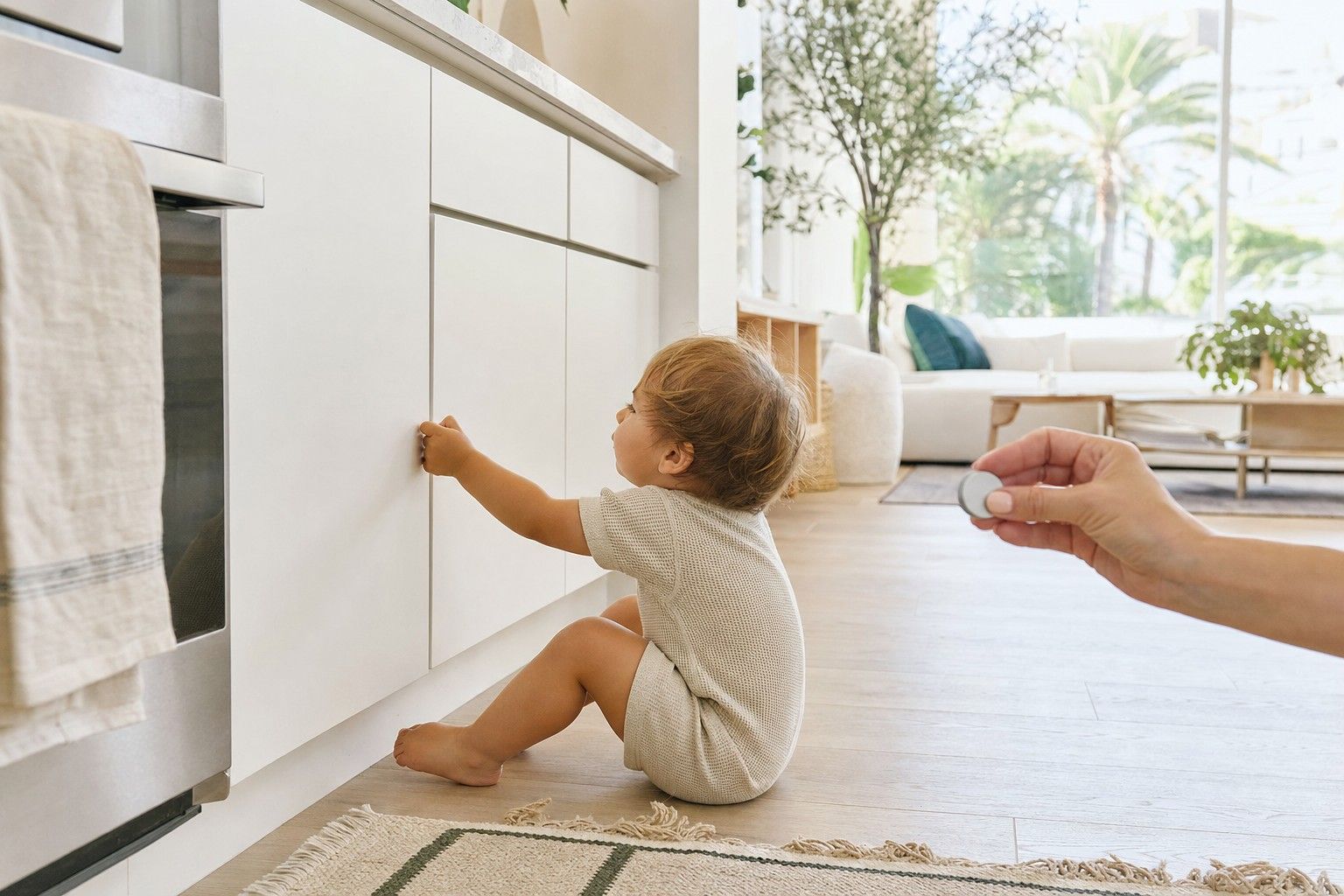
Childproof cabinet locks and door locks keep a toddler away from cleaning products, medicine, knives and the trash, and out of rooms like the garage and the laundry. The work covers hidden magnetic locks inside cabinet doors and drawers, latches on appliances and toilets, and covers or high-mounted locks on doors. Most families add them as soon as a baby starts pulling up on furniture and opening whatever is in reach.
The goal is a kitchen and bathroom you can use normally while a toddler can’t. Most of the locks open with one hand once you know where to press or where to hold the key.
Why locking cabinets and doors matters
Toddlers learn by opening things, and they learn fast by watching adults. The cabinet under the kitchen sink, the bathroom vanity and the laundry shelf tend to hold the most dangerous products in a house, often in bright packaging at exactly a toddler’s height. The U.S. Consumer Product Safety Commission (CPSC) lists safety latches and locks on cabinets and drawers among its recommended childproofing devices, as a way to keep children out of medicines and other dangerous products.
Doors are the other half. A closed door to the garage, a home office with cords and a paper shredder, or a laundry room with detergent packets works as a barrier only until a child figures out the handle. The CPSC advises that door knob covers be sturdy and still let an adult open the door quickly in an emergency, which guides how we choose them.
What we install
- Invisible magnetic cabinet and drawer locks, mounted inside so the cabinet fronts look untouched. Adults open them with a magnetic key.
- Sliding locks that loop through two side-by-side handles, useful for sink bases with knobs or pulls.
- Adhesive latches for cabinets you’d rather not drill, including lacquered and high-gloss fronts.
- Refrigerator and oven door latches, plus dishwasher and front-load washer latches.
- Stove knob covers for ranges with front-facing knobs.
- Toilet locks that keep the lid closed, which also keeps toys, phones and small hands out of the bowl.
- Door knob and lever covers, and lever locks for doors with lever handles that a toddler can push down.
- Top-of-door locks for garage, laundry, office and exterior doors, mounted above a child’s reach.
- Locks for pocket doors and sliding closet doors, which standard knob covers don’t fit.
- Drawer latches for knife drawers, junk drawers and anything holding batteries or magnets.
How installation works
We start in the kitchen and bathrooms with you, opening every cabinet and drawer and deciding together which ones need locking. Not every cabinet does. It can help to leave one low cabinet unlocked and stocked with plastic containers and wooden spoons, a toddler-approved spot that makes the locked ones less interesting.
Then we check cabinet construction. Framed and frameless cabinets take different hardware, and magnetic locks have limits on door thickness, so we measure before choosing. Push-to-open doors, common in modern European-style kitchens, need a different approach because the door opens with a press rather than a pull.
During installation we align each magnetic latch so it releases cleanly on the first try, mount appliance latches where they won’t interfere with door seals or vents, and set door locks at a height that works for the shortest adult in the house. We hand over the magnetic keys, suggest a spot to keep one in each room, and show everyone who looks after your child how each latch works.
Adhesive latches need time to set, so we tell you when they can take a pull. A week later is a good moment to see which locks annoy you, since a lock that annoys an adult tends to get left open.
Design-friendly and renter-friendly options
Magnetic locks are the design-friendly default because nothing shows from the outside. For appliance latches, we choose finishes close to the appliance, usually stainless-look, white or black. Lever locks and knob covers come in clear or neutral colors, and top-of-door locks sit above eye level where few people notice them.
For renters, adhesive latches and sliding handle locks leave no holes, and toilet locks and knob covers need no tools at all. Magnetic locks require a few small screws, but they go inside the cabinet, out of view. When you move, the holes are tiny and inside the box. Our childproofing checklist lists which rooms usually need locks first if you’re doing this in stages.
Cabinet and door locks in Los Angeles homes
Original 1920s cabinets survive in many Spanish Revival and Craftsman kitchens in Los Angeles, while recent remodels favor frameless, handleless cabinetry. Original cabinets often have inset doors and thin frames that limit hardware choices. Modern kitchens with stone counters and push-latch doors need locks that work with the push mechanism. Both are solvable, but they take different hardware.
Earthquakes add a second reason for latches here. A cabinet latch that keeps a toddler out also keeps doors from swinging open in strong shaking, which keeps glassware, dishes and cleaning products off the floor. If you’re planning earthquake safety work, we can choose latches for both jobs at once.
Many Los Angeles homes have attached garages with a door straight from the kitchen or laundry room, and many have backyard pools. A high lock on the door to the garage or the pool deck adds a layer. It doesn’t replace the pool barriers explained in our guide to California pool safety rules. Pocket doors, common in both older homes and new builds with tight floor plans, get their own locks.
Related services
Cabinet and door locks are usually part of a whole-house plan from a home safety assessment. Kitchens and bathrooms often get outlet and electrical safety work at the same time, since outlets near counters and vanities sit within a climbing toddler’s reach. In Los Angeles, the same latches serve earthquake safety as well.