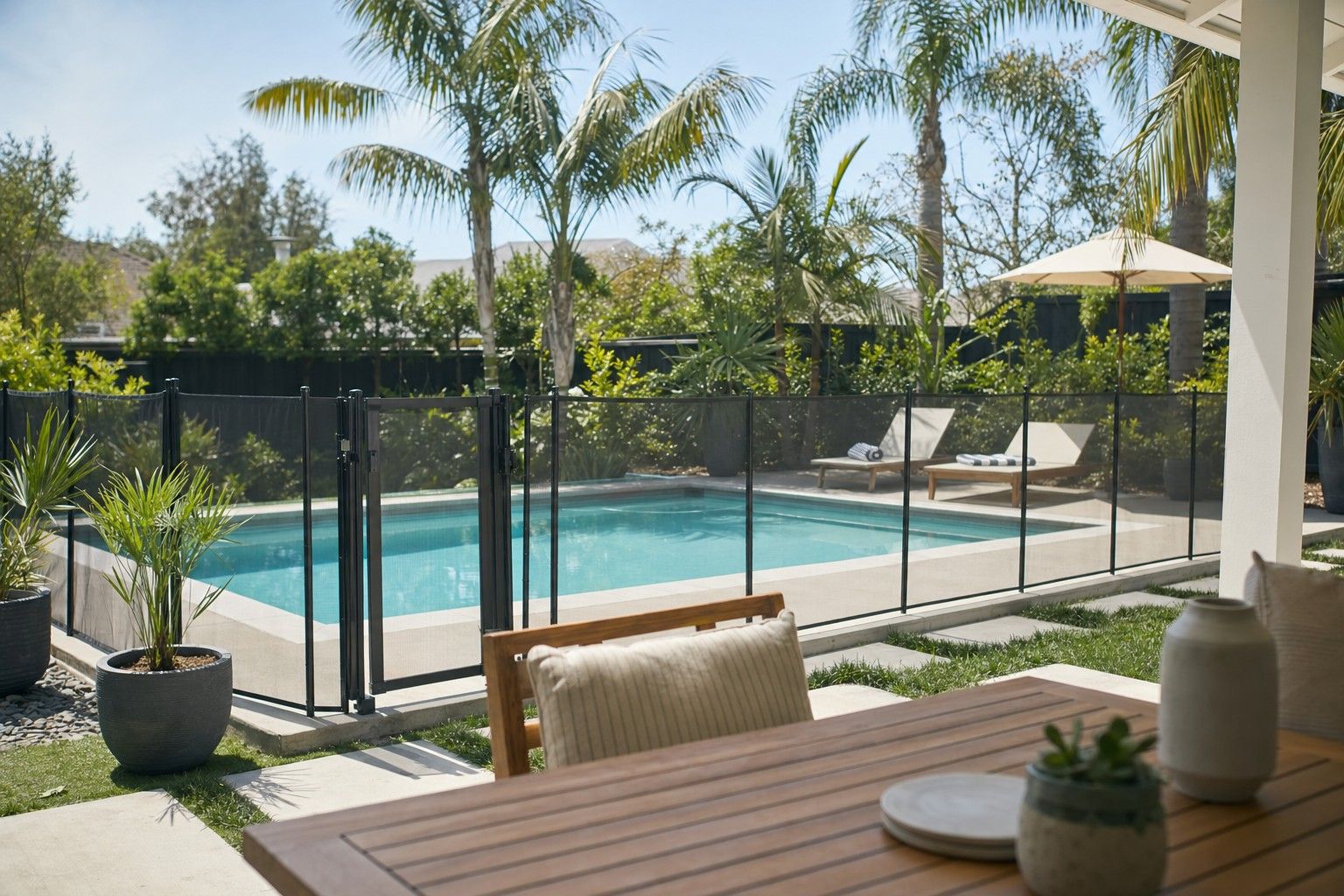
California’s Swimming Pool Safety Act requires a pool or spa at a private single-family home to have at least two of seven listed drowning prevention safety features whenever a building permit is issued to build it or remodel it. A pool safety fence that isolates the water from the house is one of the seven, along with safety covers, door and window exit alarms, self-closing door hardware with a high latch, and pool alarms. The two-feature rule has been in effect since January 1, 2018, under SB 442, and SB 552 updated the feature definitions as of January 1, 2025.
The law sets a minimum for permitted work. Pediatricians and federal safety agencies recommend more for any home where young children live or visit, starting with a fence on all four sides of the pool.
What California’s pool safety law requires
The Swimming Pool Safety Act is Article 2.5 of the California Health and Safety Code, Sections 115920 to 115929. Section 115922 holds the main rule. When a building permit is issued for a new pool or spa, or for remodeling an existing one, at a private single-family home, the pool or spa must be equipped with at least two of the seven features the law lists. Before the job gets final approval, the local building official inspects those features.
A few details families often miss:
- The trigger is the building permit. Section 115922 doesn’t, on its own, require an older pool with no permitted work to add features, though your city or county may have its own rules.
- The act covers single-family homes. Section 115925 says it doesn’t apply to public pools, to apartment complexes or other residential settings beyond a single-family home, or to hot tubs and spas with locking safety covers that meet the ASTM F1346 standard.
- SB 442, signed in October 2017, set the two-feature requirement that took effect January 1, 2018.
- SB 552, in effect since January 1, 2025, rewrote how several features are defined and listed pairings that no longer count toward the two.
If you’re planning a new pool or a remodel, ask your pool builder which two features they’re designing for and which standard each one meets.
The seven drowning prevention safety features
Paraphrased from Section 115922, the seven features are:
- An enclosure that meets Section 115923 and isolates the pool or spa from the house. This is the pool safety fence.
- Removable mesh fencing that meets the ASTM F2286 standard, paired with a gate that is self-closing, self-latching and able to take a key lockable device.
- A manually operated or power-operated safety pool cover with a label showing it meets the ASTM F1346-23 standard.
- Exit alarms on the home’s doors and windows that open directly to the pool or spa with no enclosure in between. Whenever one is opened or left ajar, the alarm has to sound continuously or repeat a spoken warning, such as “the door to the pool is open.”
- A self-closing, self-latching device on the home’s doors that lead directly to the pool or spa, with the release mechanism placed no lower than 54 inches above the floor.
- A pool alarm, kept in good repair and certified to the ASTM F2208 standard, that sounds when someone enters the water. An alarm designed for individual use, such as one attached to a child, does not qualify.
- Another means of protection that gives equal or greater protection, verified by an approved testing laboratory against an ASTM, ASME or other nationally recognized standard, and labeled to show it.
Pairings that don’t count
Since SB 552, three combinations do not satisfy the two-feature rule:
- An exit alarm and a self-closing, self-latching device on the same door
- An exit alarm on one door and a door latch on a different door
- A safety pool cover together with a pool alarm
The SB 552 changes also reached home inspections. When a home with a pool is inspected for a sale, the inspection is meant to identify which of the seven features are present and whether each one is in good repair, operable as designed and labeled, and to put that in the report.
What a compliant pool safety fence looks like
Section 115923 spells out what counts as an enclosure. It needs:
- A minimum height of 60 inches
- No more than 2 inches of vertical clearance between the ground and the bottom of the fence
- Gaps or openings small enough that a 4-inch sphere can’t pass through
- An outside surface without protrusions, cavities or other features a child under five could use as handholds or footholds to climb over
- Gates that open away from the pool and are self-closing, with a self-latching device at least 60 inches above the ground
The American Academy of Pediatrics (AAP) guidance on HealthyChildren.org lines up with this. The AAP recommends a fence on all 4 sides of the pool, at least 4 feet high, with no opening under it or between slats wider than 4 inches, that completely separates the pool from the house and the rest of the yard. The gate should be self-closing and self-latching, with the latch at least 54 inches from the ground. The CDC gives the same core advice, a four-sided fence at least four feet tall that fully encloses the pool and separates it from the house.
California’s 60-inch height is taller than the 4-foot minimum in the AAP and CDC guidance, so a fence built to the state spec meets both. A fence that uses the house as its fourth side leaves the back doors as the weak point, which is where exit alarms and high door latches come in.
Layers of protection around a home pool
The AAP says no single method can prevent all drownings, and it recommends several layers of protection. Each layer fails sometimes. A gate gets propped open during a party, a door alarm gets switched off because it’s annoying, an adult looks down at a phone. The next layer is there for that moment.
The risk is concentrated at home and among the youngest children. According to the CDC, more children ages 1 to 4 die from drowning than from any other cause. The CPSC’s Pool Safely campaign reports that an average of 357 children younger than 15 died each year from 2020 through 2022 in pool- or spa-related drownings, and that 85 percent of those incidents with a known location happened at a residence, such as a backyard pool. Children ages 1 to 3 made up 68 percent of the reported deaths.
Think about the layers in four groups:
- Barriers, meaning a four-sided fence, self-closing and self-latching gates, door alarms and a safety cover kept on when the pool isn’t in use
- Supervision, which the AAP describes as touch supervision within arm’s length for young children, plus a designated water watcher who keeps eyes on the child and hands off the job on a set schedule
- Skills, since the AAP says children can begin swim lessons after their first birthday, depending on readiness
- Readiness at the pool, meaning a charged phone, rescue equipment within reach and adults who know CPR
A pool-area checklist for parents
- The gate closes and latches by itself from any open position, including half open
- The gate swings away from the pool, and the latch is out of a child’s reach
- Nothing near the fence can be used as a step, including patio chairs, planters, coolers and the grill
- Every door and window that opens toward the pool has an alarm, a high latch or both
- Sliding and folding glass doors to the deck have a lock mounted high on the frame
- Pet doors don’t open into the pool area
- The spa cover is locked whenever nobody is using it
- Pool toys come out of the water after swim time, so they don’t draw a child back
- A phone and rescue gear are at the pool before anyone gets in
- Sitters, grandparents and visiting families know the gate stays closed
Who installs pool fences, and how we help
Childproofing LA does not install pool fences. That work needs a specialty contractor license, so a new enclosure, removable mesh fencing or a safety cover goes to a contractor who does pool barrier work.
What we do is look at the pool area as part of the house. Many Los Angeles homes are built for indoor-outdoor living, with wide sliding or folding glass walls that open straight onto a pool deck, and on hillside lots the pool is often a few steps from the kitchen. During a home safety assessment, we walk the doors, windows and gates that lead to the water and point out the risks we see: a slider whose only lock sits at toddler height, a side gate that doesn’t latch, a dog door that opens onto the deck, a lounge chair a child could drag to the fence.
Those notes go into your itemized plan. You’ll know what to hand to a fence contractor and what can be handled inside the house, such as window safety devices on windows that face the pool.
When to call a professional
Call a pool barrier contractor for the fence itself, mesh fencing or a safety cover, and check with your local building department before any pool work. For everything between the house and the water, book a home safety assessment. A baby gate installation across a hallway or family room can keep a toddler away from the doors to the pool, and our childproofing checklist covers the rest of the house.
Sources
- California Legislative Information: Health and Safety Code, Article 2.5, The Swimming Pool Safety Act (Sections 115920 to 115929)
- California Legislative Information: SB 552, Public safety: pools and spas (2023 to 2024)
- AAP HealthyChildren.org: Water Safety and Young Children
- CDC: Preventing Drowning
- Pool Safely (CPSC): CPSC Releases Annual Drowning Report, Emphasizes Importance of Pool Barriers