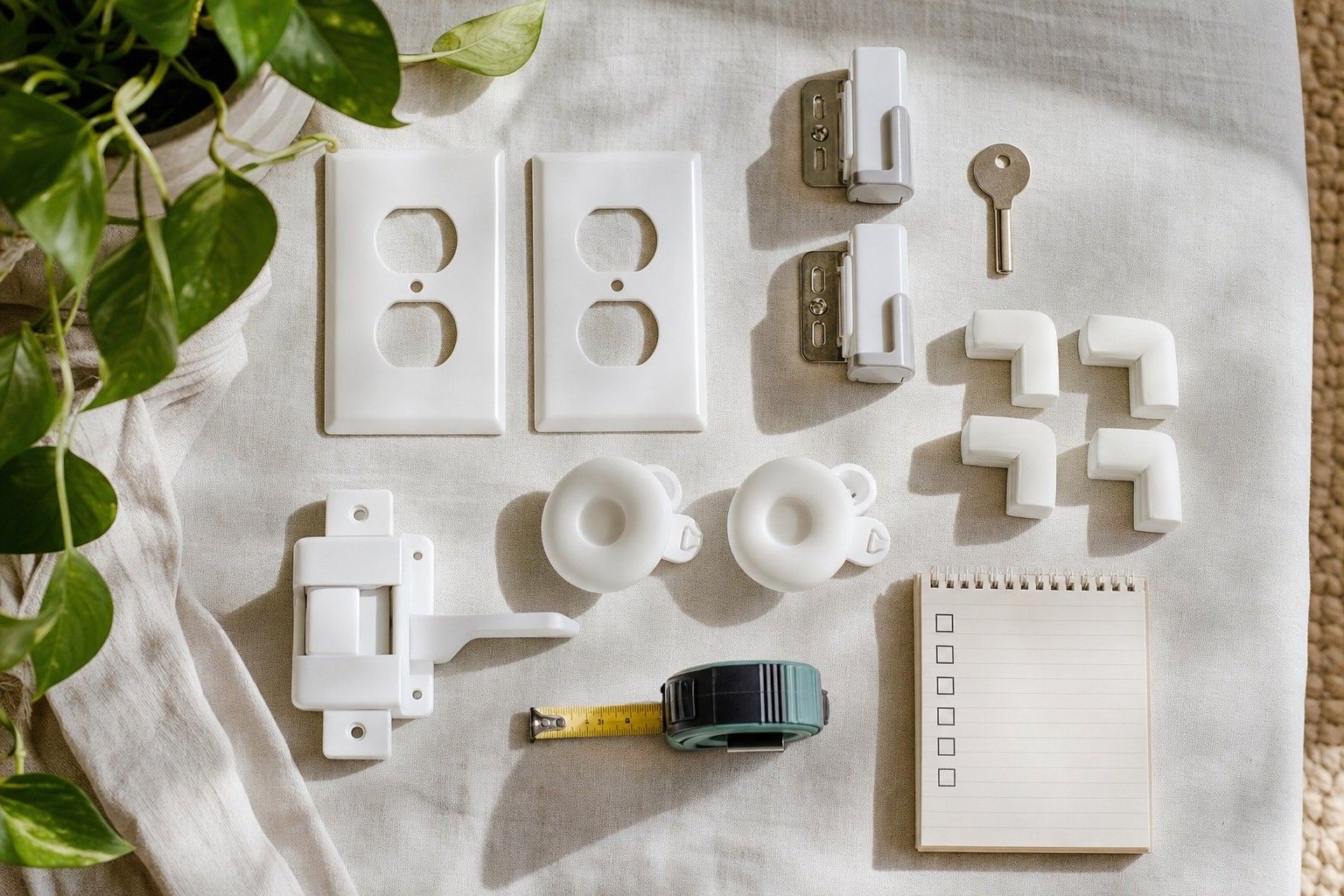
This childproofing checklist splits the work into four rounds, each one finished just before your child picks up a new skill: before the baby arrives, at rolling and crawling, at cruising and walking, and at climbing. Go through the house room by room in each round and you stay a step ahead of your child. The items below follow guidance from the U.S. Consumer Product Safety Commission (CPSC) and the American Academy of Pediatrics (AAP).
How to use this childproofing checklist
Start on the floor. Sit or crawl through each room at your baby’s height and you will spot the outlet behind the sofa, the cord hanging from the blinds and the dishwasher pods under the sink. Those are the things a baby finds first.
Each stage below lists what to add in that round, grouped by room. The ages are rough guides drawn from the AAP’s milestone pages, and every child moves at a different pace, so watch for the skill and ignore the birthday. If your baby is pulling up on the coffee table at eight months, jump ahead a section.
The CPSC adds a fair warning to its own childproofing guide: no safety device is completely childproof, and determined toddlers have been known to defeat them. Latches and gates slow a child down and lower the risk. Supervision covers the rest.
Before your baby arrives
This round covers the jobs that are hard to do with a newborn in your arms, such as drilling, moving heavy furniture and setting up the nursery. It is also when you have the most time to think about how each room will work day to day.
Nursery and bedrooms
- Set up a crib, bassinet or play yard that meets CPSC safety standards, with a firm, flat mattress and a fitted sheet. The AAP’s safe sleep guidance keeps pillows, blankets and bumper pads out of the sleep space.
- Plan a safe sleep spot in your own bedroom too. The AAP recommends sharing a room with your baby for at least the first six months.
- Anchor the dresser, changing table and any bookcase to wall studs.
- Replace corded blinds and shades in the nursery with cordless ones, which the CPSC recommends for homes with young children.
- Place the crib away from windows and keep heavy frames, shelves and mirrors off the wall above it. In Los Angeles this habit also counts as earthquake prep.
The whole house
- Put smoke alarms on every level, inside each bedroom and outside sleeping areas, and test them monthly, as the CPSC advises.
- Install carbon monoxide alarms outside bedrooms, near each sleeping area.
- Set the water heater to 120°F or lower to reduce the risk of scalds at the tub.
- Save the Poison Help line in every caregiver’s phone, including the nanny’s and the grandparents’.
- Anchor the TV and any tall furniture in the family room, where you will spend most of the newborn months.
Rolling and crawling (about 4 to 8 months)
Rolling usually comes first. Crawling follows, and the AAP describes it as a skill usually mastered between seven and ten months, though some babies scoot or shuffle instead. Once your baby can move, everything at floor level is within reach, so aim to finish this round before the first real crawl.
Kitchen and laundry
- Add latches or magnetic locks to lower cabinets and drawers that hold cleaners, dishwasher pods, knives or plastic bags.
- Move cleaning products up high as well. The CPSC advises locking them away even when the packaging is child-resistant.
- Put a lock on the dishwasher and the front-loading washer if your baby can reach the doors.
Bathrooms
- Lock the cabinet or drawer that holds medicines, vitamins and razors.
- Add a toilet lock, or keep bathroom doors closed with a door knob cover.
Living areas, hallways and stairs
- Install gates at the top and bottom of every staircase. For the top of stairs, the CPSC says to use only gates that screw to the wall.
- Cover unused outlets with covers a child can’t easily remove and that are too large to choke on, or switch to tamper-resistant receptacles.
- Tuck lamp and charger cords behind furniture, and stand floor lamps behind sofas or chairs, as the AAP suggests.
- Add edge guards to a stone or brick fireplace hearth. Pick ones that stay firmly attached, since a loose bumper becomes one more thing to put in the mouth.
- Sweep the floor for small objects. The AAP singles out button batteries, coins and balloon pieces as especially dangerous.
Cruising and walking (about 9 to 15 months)
The AAP notes that many babies take their first steps around their first birthday. In the months before that, they pull up on anything in reach and cruise along the furniture, so every piece they lean on has to stay put.
Every room
- Anchor bookcases, dressers, media consoles and TV stands to the wall. The AAP includes this in its home safety tips, and our furniture and TV anchoring page explains how it is done in different wall types.
- Mount flat-screen TVs to the wall, or strap them to a low, sturdy stand.
- Pad the sharp corners of coffee tables and side tables, or store the worst offenders for a year.
- Clear the tops of dressers and shelves of toys and remotes that tempt a child to climb.
Kitchen
- Install the anti-tip bracket on a stand-alone range. The CPSC lists ranges, along with furniture and TVs, as items that can tip over and crush a young child.
- Add stove knob covers and an oven lock.
- Move heavy or breakable items off low shelves and open racks.
Doors and exits
- Put door knob covers or lever locks on the doors to the garage, laundry room, office and any room with outside access.
- Add a door alarm or a high latch on doors that lead to a pool, a spa or the street. The CPSC recommends layers of protection around pools, starting with self-closing, self-latching doors or door alarms.
Climbing toddler (about 18 months and up)
The AAP’s safety page for ages one to two describes children who walk well and start to climb, jump and run. A chair pushed next to a counter or a window turns into a ladder. This round moves hazards higher and closes off the drops.
Windows, balconies and railings
- Limit window openings to four inches or less with window stops, or install operable window guards. Both the CPSC and the AAP point out that a screen will not stop a child from falling.
- Keep beds, chairs, sofas and toy chests away from windows.
- Check balcony and stair railings. If a child could squeeze between the balusters or climb the rails, add clear railing guards.
Kitchen, bathrooms and storage
- Keep medicines and household products completely out of sight and reach, in the AAP’s words. Climbers get onto counters, so upper cabinets with medicines need latches too.
- Add a refrigerator lock if your toddler has worked out the door.
- Lock the garage cabinet that holds paint, pool chemicals and car products.
Stairs and gates
- Leave the stair gates up even after your child learns to climb the stairs. The AAP says to keep the stairs gated at all times.
- Check every gate every few months. Hardware loosens, and a toddler leaning on a gate tests each screw.
Additions for Los Angeles homes
Most printed checklists assume a simple two-story house on flat ground. Homes here often add a few items worth planning for.
- Earthquakes. The anchors and latches you add for a toddler also help keep furniture standing and cabinet doors shut when the house shakes. Strap the water heater while you are at it.
- Hillside and multi-level homes. Long stair runs, split-level landings and decks with a drop on one side need gates and railing guards at each change in level.
- Pools and spas. Plan door alarms and latches on every door that opens toward the water. We don’t install pool fences, but we point out pool-area risks during the assessment.
- Older Spanish Revival and Craftsman homes. Plaster walls, tile and thick wood newel posts call for different fasteners than modern drywall.
- Sliding glass doors. A secondary lock mounted high keeps a toddler from opening the slider to the patio.
When to call a professional
A checklist tells you what to do. The harder part is often how: finding a stud behind lath and plaster, fitting a gate to a round banister, or latching custom cabinetry without marking it. Those are the jobs where the right hardware matters most.
Our home safety assessment walks through each room with you and produces an itemized plan for your house and your child’s stage. From there we can fit hardware-mounted baby gates, install cabinet and door locks that suit your finishes, and add window stops and guards. If you are still expecting, our guide on when to start babyproofing covers timing.
Sources
- Childproofing Your Home: Several Safety Devices to Help Protect Your Children from Home Hazards, U.S. Consumer Product Safety Commission
- Home Safety: Tips for Families With Young Children, HealthyChildren.org (American Academy of Pediatrics)
- Movement Milestones in Babies 8 to 12 Months Old, HealthyChildren.org (American Academy of Pediatrics)
- Safety for Your Child: 1 to 2 Years, HealthyChildren.org (American Academy of Pediatrics)
- How to Keep Your Sleeping Baby Safe: AAP Policy Explained, HealthyChildren.org (American Academy of Pediatrics)