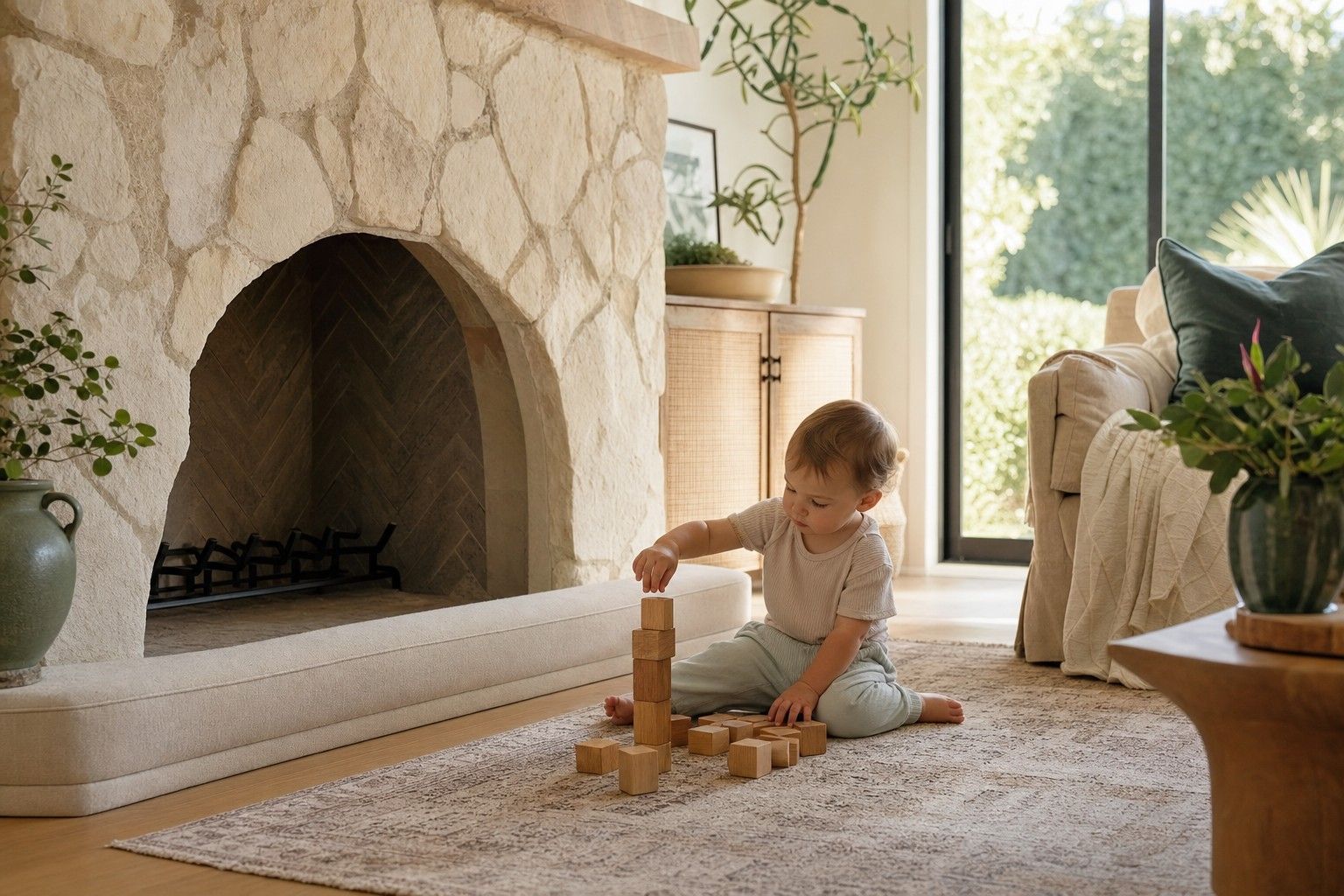
Fireplace childproofing protects small children from a hearth’s hard edges, which they fall against while learning to walk, and from the heat of a fire or a hot glass front. We pad the hearth, put a gate or screen between the child and the firebox, and cover or lock the gas key, wall switch and remote. It applies to wood-burning and gas fireplaces alike, and it becomes urgent once a baby starts cruising along furniture.
A fireplace is often the focal point of a living room, so the work has to look like it belongs there. Pads get matched to the stone, and gates are chosen to read as part of the hearth.
Why fireplace childproofing matters
Many hearths are raised, made of stone, brick or tile, and finished with square corners close to the height of a toddler’s head. The U.S. Consumer Product Safety Commission (CPSC) recommends corner and edge bumpers to help prevent injuries from falls against sharp edges of furniture and fireplaces. A padded edge takes the sting out of the falls that come with learning to walk.
Heat is the second risk, and gas fireplaces with glass fronts deserve particular attention. The Hearth, Patio & Barbecue Association (HPBA) says the glass can become very hot during operation and stay hot long afterward, and that cool-down can take an hour or more. Since January 1, 2015, newly manufactured glass-front gas fireplaces and stoves have had to include a protective barrier when the glass surface exceeds 172 degrees Fahrenheit. Units made earlier may have no barrier at all, and HPBA advises their owners to consider a protective screen or physical barrier.
Wood-burning fireplaces bring open flame, sparks, hot screens and fireplace tools that are heavy and sharp. Gas fireplaces add a key valve or switch that a curious child can turn.
What we install
- Padded hearth guards: cushioned bumper strips that run the length of the hearth edge, in colors chosen to match stone, brick or tile.
- Corner cushions for raised hearth corners and the edges of stone surrounds.
- Fireplace gates that span the hearth and mount into the wall on both sides, or configurable panel gates that wrap around a hearth that sticks out into the room.
- Barrier screens for glass-front gas fireplaces. When the manufacturer makes a barrier for your model, that’s our first choice, since HPBA cautions that aftermarket screens attached to the unit could affect how it operates.
- Gas key valve covers and locking caps, so the valve can’t be turned by small hands.
- Wall switch covers and switch locks for gas fireplaces that light from the wall.
- High-mounted holders for fireplace remotes, and a latched spot for the gas key.
- A plan for fireplace tools and log holders, which usually means moving them out of reach or into a closed cabinet.
How installation works
The first step is identifying the fireplace type: open wood-burning, gas logs in a masonry firebox, a gas insert, or a sealed direct-vent unit with a glass front. Each one gets hot in different places. We also look at the hearth, including its height, depth, material and how far it projects into the room.
Hearth guards go on first. Stone and tile vary in texture and finish, so we test the adhesive on a hidden spot before committing, especially on porous stone like limestone or slate that can stain. The guard is cut to length and wrapped around the corners so there’s no exposed edge.
Next comes the barrier. A wall-mounted hearth gate needs studs or masonry on both sides of the fireplace, at a distance that respects the manufacturer’s clearance to the firebox. Where the fireplace sits in the middle of a wall of built-ins, a configurable gate that wraps the hearth can work instead.
Last, we cover the controls and walk you through everything. Our childproofing checklist puts the fireplace in context with the rest of the house.
Design-friendly and renter-friendly options
Hearth guards come in neutral grays, browns, black and off-white, so they can match a stone or brick hearth closely. For homes where the fireplace is a design centerpiece, a slim black metal gate reads as part of the hearth hardware, and it comes down easily once children are old enough.
Barrier screens made by the fireplace manufacturer look like part of the unit because they were designed for it. Remote holders and switch covers are small, and white or neutral finishes keep them low-key.
Renters can use hearth guards, which attach with adhesive and come off without tools, and configurable gates that stand around a hearth with fewer wall mounts. If a wall mount is needed, it goes into a stud and leaves small holes that patch easily.
Fireplace safety in Los Angeles homes
Fireplaces are a familiar feature across Los Angeles, even though they get used mostly on cool winter evenings. Craftsman homes, common in Pasadena and older parts of the city, often have brick, clinker brick or river rock fireplaces with wide, rough hearths that need careful padding. Spanish Revival houses tend to have plaster surrounds and tiled hearths, sometimes with decorative tile that’s easily chipped by a careless drill.
Mid-century homes favor long raised hearths that run the full width of a wall, sometimes doubling as bench seating. Those make a natural climbing platform for toddlers and usually need a long gate or panel system. Newer homes and remodels often have linear glass-front gas fireplaces set into the wall with a large TV mounted above, which raises both burn and tip-over questions. We pair those installs with furniture and TV anchoring when the TV or a console sits nearby.
Outdoor fireplaces and fire pits on patios are common too. They get the same treatment, with a barrier where one fits, covers for any gas controls, and patio furniture arranged so a toddler can’t climb toward the fire.
Related services
Fireplace work fits inside a home safety assessment, which looks at the hearth along with every other room. Wide hearths often use the same panel gates we fit through baby gate installation, and fireplaces with TVs above them usually need anchoring as well.