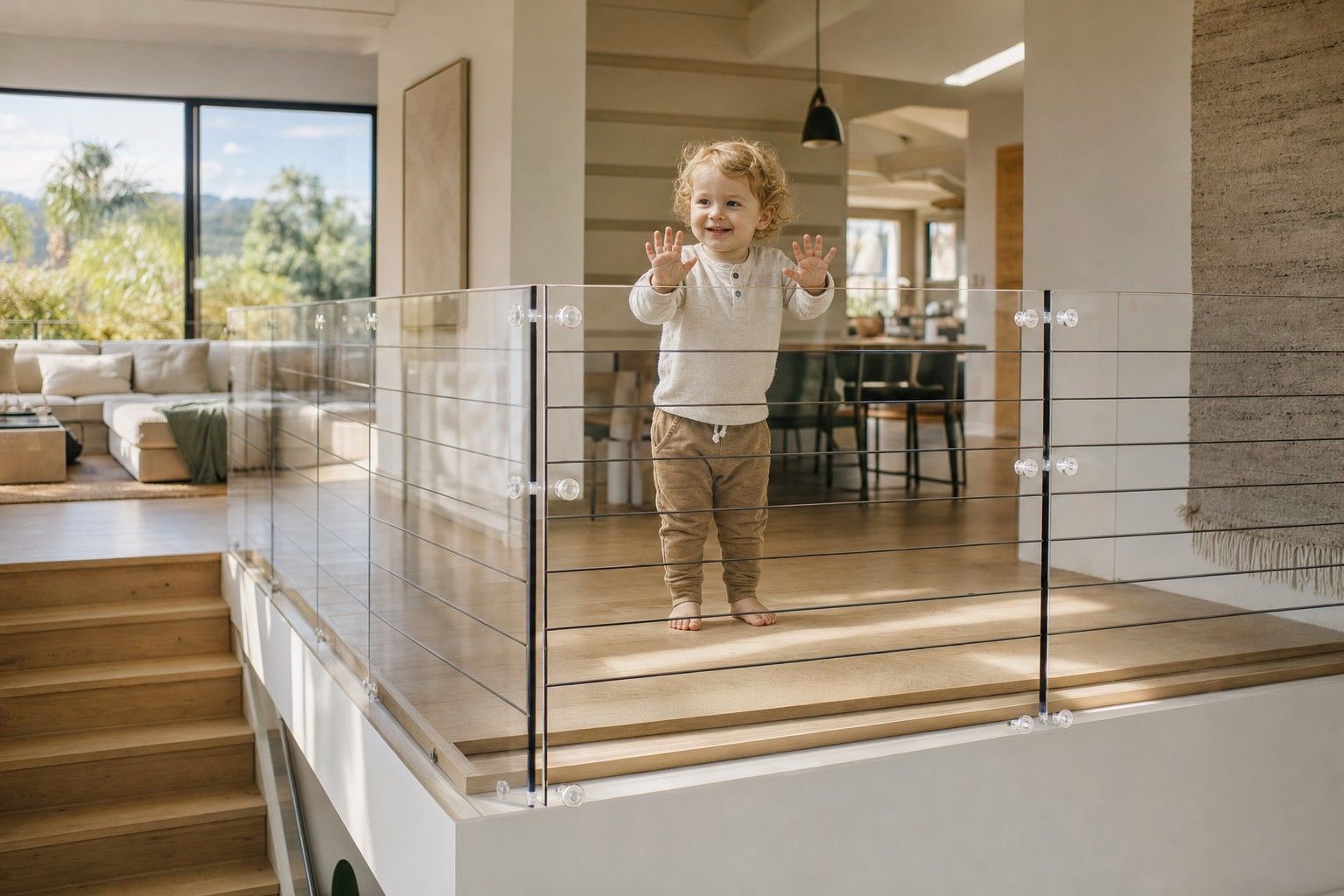
Stair railing guards are clear acrylic panels or mesh netting fastened along a railing so a child can’t slip through the gaps or use the rails as a ladder. We fit them on staircases, balconies, lofts, landings and open risers, indoors and outdoors. They matter most in homes with horizontal bar or cable railings, wide baluster spacing, or a loft or balcony that looks down into a living room.
A railing’s height is set with adults in mind. A toddler’s risk is different: going through the gaps, under the bottom rail, or up the rails themselves. Guards cover all three routes.
Why stair railing safety matters
Current residential building codes in California generally don’t allow a 4-inch sphere to pass through the openings in a required guard on a landing, deck or balcony, with a slightly larger limit along the open side of a stair. That rule has evolved over time, and many older homes were built with wider spacing between balusters. Some newer homes meet the opening rule while using horizontal bars or cables, which give a climbing child a foothold every few inches.
The U.S. Consumer Product Safety Commission (CPSC) recommends window guards and safety netting to help prevent falls from windows, balconies, decks and landings. In practice, the riskiest railings are the ones over a long drop: an open stairwell in a multi-level house, a loft over a double-height living room, a second-floor deck.
What we install
- Clear acrylic (plexiglass) shields cut to fit the railing and attached on the inside, so the design stays visible while gaps and footholds are covered.
- Mesh banister netting for long runs, curved staircases and railings with many balusters, in clear-look, white or black.
- Climb guards for horizontal bar and cable railings, running full height so there’s no lowest rung to start from.
- Bottom-gap closures where the space between the bottom rail and the floor or stair treads is wide enough for a child to slide under.
- Open riser covers for floating and open-tread stairs, so a child can’t put a leg or head through the gap between steps.
- Loft and balcony guards for interior lofts, mezzanines and exterior balconies.
- Coordinated gate and guard setups, so a baby gate at the top of the stairs and the railing beside it protect the same opening.
How installation works
The visit starts with the railing type, since it decides the attachment method. Wood balusters, wrought iron, steel bars, cables and glass panels each take different fasteners. We measure the gaps, the height of the railing, and the space under the bottom rail, and we look at what’s on the other side of each run.
We then choose material run by run. Acrylic goes where climbing is the main risk or where the railing is a design feature you want to keep visible. Netting goes where runs are long or curved. On stairs, acrylic panels get cut to the stair angle so they follow the rake of the railing without large gaps at the ends.
Installation uses ties or clamps that wrap the railing, which means no holes in finished wood or metal. We pull each tie snug, trim the tails, ease any sharp acrylic edges, and test by pushing and climbing on the panels the way a toddler would. Outdoors, we use UV-stable materials, rust-proof fasteners and a small drainage gap at the bottom.
When a gate shares the opening, as it often does at the top of a staircase, we install both in the same visit so the gate’s mounting and the guard’s ties don’t interfere. Our guide on baby gates for stairs with banisters shows how the two work together.
Design-friendly and renter-friendly options
Clear acrylic suits a house where the railing is part of the architecture. From a few feet away it all but disappears, so a statement railing or a canyon view stays the focus. It does show fingerprints and can scratch, so we leave cleaning instructions: a soft cloth and a cleaner made for acrylic, never a glass cleaner with ammonia. Netting is more visible, but black netting against a dark iron railing reads as part of the railing.
Because most guards attach with ties and clamps, they’re naturally renter-friendly. Nothing is drilled into the railing, and the whole system comes off in an afternoon when your child is older or you move. Condo owners with exterior balconies should check HOA rules about visible changes, and we can recommend clear options that are least likely to raise questions.
Stair railing guards in Los Angeles homes
Multi-level living is common in Los Angeles. Hillside houses in neighborhoods like the Hollywood Hills are often built in several stacked levels, with open stairwells, landings that look over a drop, and decks hanging off the downhill side. Those homes can need guards on every level, plus gates at each flight.
Mid-century post-and-beam houses and new contemporary builds tend to use horizontal rails, cables and floating stairs. They look good and they’re easy to climb, so acrylic shields are the usual answer. Spanish Revival homes bring wrought-iron railings with decorative scrolls and uneven gaps, which netting handles well.
Along the coast, beach houses and townhomes often have upper decks and balconies facing the water. Salt air is hard on hardware, so outdoor installs there get stainless fasteners and UV-rated netting. High-rise condos usually have solid or glass balcony walls, but furniture near the edge can still become a step, and we look at that too.
Related services
Railing guards usually go in alongside baby gate installation, since stairs need both a gate and a closed railing. Windows on upper floors and lofts get stops or guards through our window safety service. Households with cats on balconies can add netting built for pets through pet-proofing.