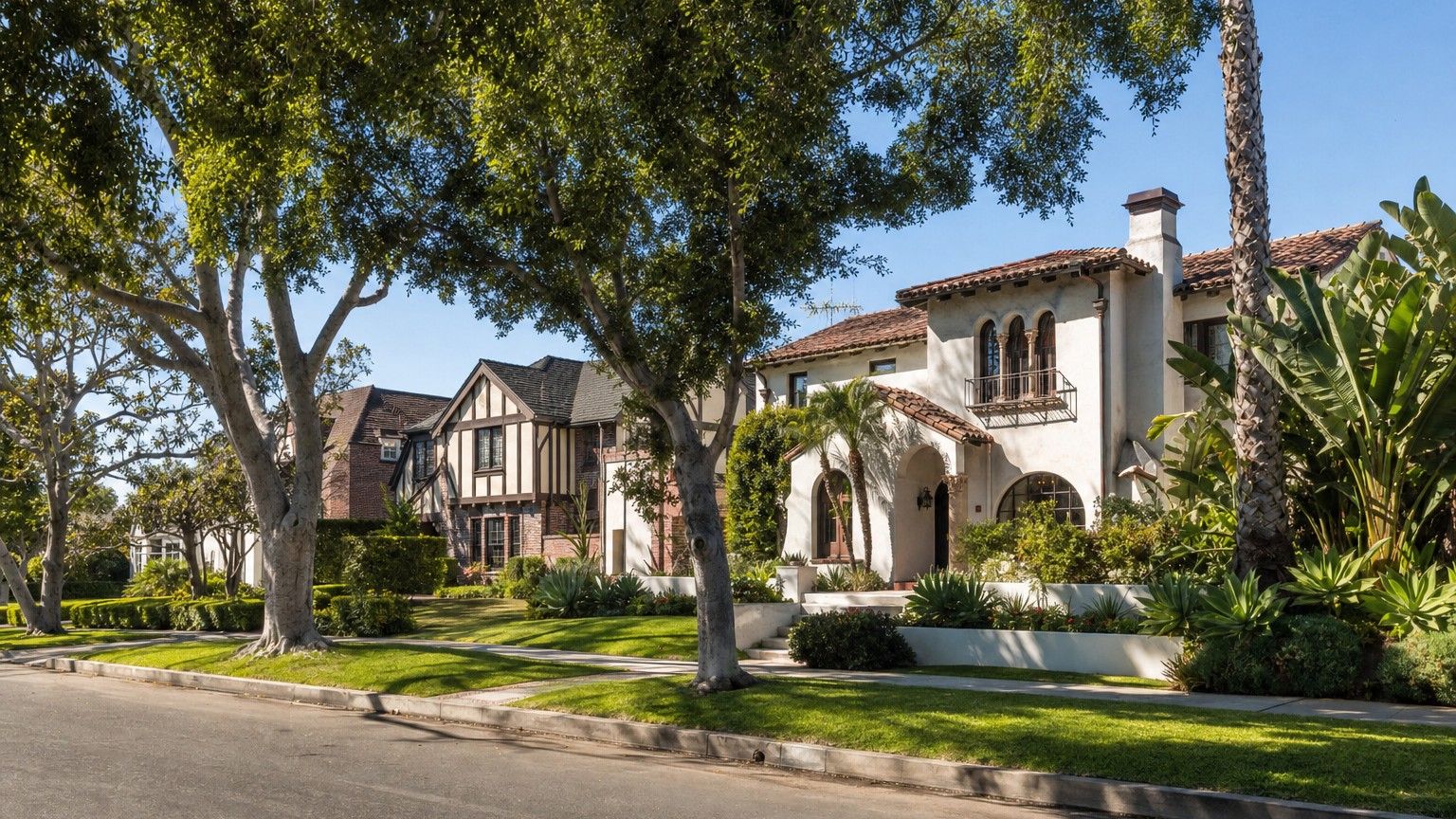
Childproofing in Hancock Park and Larchmont usually starts at the staircase. Most houses here are two-story Period Revival homes from the 1920s and 1930s, in Tudor, Spanish Colonial, Mediterranean and Colonial Revival styles, and the banisters, tile and hardwood are the parts owners least want marked. We assess the house, write an itemized room-by-room plan, and install gates, guards, anchors and locks suited to the original materials.
Parents in these homes usually raise three things first. They want to know how to gate a grand stair without damaging the rail, what to do about the fireplace, and how to keep a toddler away from windows built decades before anyone worried about window falls.
Homes in Hancock Park & Larchmont and what they need
The City of Los Angeles adopted the Hancock Park Historic Preservation Overlay Zone in 2006. Its preservation plan describes a district built mostly in the 1920s and 1930s: two-story houses on spacious lots, set back behind raised front lawns, with brick or concrete steps to a formal entrance and side driveways that run under a porte cochere to a garage at the rear. The residential streets around Larchmont Boulevard, whose shops date to 1921, have a similar stock of older homes.
Inside, that era leaves a clear pattern. Main staircases tend to be wide, with turned balusters and heavy newel posts, and some sweep out at the bottom into a curved first step. Spanish Revival houses may carry decorative tile up the stair risers and around the fireplace. Walls are usually plaster, which holds a screw differently from drywall and cracks if it is drilled carelessly.
People ask whether the HPOZ limits childproofing. The Hancock Park Preservation Plan lists interior improvements among the work exempt from HPOZ review, so a gate or a cabinet lock generally doesn’t need HPOZ review, unless the house is under a Historical Property Contract. We still avoid drilling into original woodwork wherever a clamp, a strap or a hidden mount will do the same job, because a stripped newel post can’t be replaced from a catalog.
Common childproofing projects in Hancock Park & Larchmont
- A gate screwed into solid framing at the top of the main stair, since a pressure gate can push out. Where the newel post is too valuable to drill, our baby gate installation uses a banister clamp kit.
- A second gate at the bottom, sized for the wide first step many period staircases have, sometimes angled to clear a curved tread. The mounting options are laid out in baby gates for stairs with banisters.
- Clear acrylic panels along balustrades where the gaps between spindles are wide enough for a small child to squeeze through or get a head stuck.
- Padded hearth edges and a fireplace gate for wood-burning fireplaces with raised stone or tile hearths. See fireplace safety for the options.
- Window stops or limiters on original double-hung sashes and steel or wood casements, set so each window opens no more than four inches, the limit the U.S. Consumer Product Safety Commission (CPSC) recommends.
- Anchors for armoires, antique dressers and tall bookcases. The federal stability standard for clothing storage units applies only to units made since September 1, 2023, so an antique or inherited dresser was never required to meet it.
- Locks inside the doors of kitchen and butler’s pantry cabinets, so the original pulls and latches stay as they are.
Earthquake, outdoor and pool safety in Hancock Park & Larchmont
On Hancock Park’s flat streets, a family’s earthquake risk is mostly what stands inside. Tall bookcases, china cabinets, mirrors over a mantel and art above a crib all need anchoring or secure hangers. In plaster we find the studs first and use fasteners suited to the wall, so the anchor holds and the plaster stays intact.
State law covers the water heater too. California Health and Safety Code §19211 calls for it to be braced, anchored or strapped against falling or moving during an earthquake. A heater in a 1920s house has likely been swapped more than once, so we check the straps wherever it sits.
Outside, the long side driveway is the part of the lot we point out first. A child playing in the back garden is often a few steps from where cars back out of the rear garage, and the plan notes which doors and gates open onto that path.
If the back garden has a pool, state law comes into play when you build or remodel it. Under the California Swimming Pool Safety Act, as amended by SB 442 in 2018, a building permit for a new pool or spa, or for remodeling one at a single-family home, brings a requirement for at least two of seven listed drowning-prevention features. Pool fences are outside our work because they require a specialty contractor license, but the assessment covers each door and route a child could take toward the pool.
What a visit looks like
Book the assessment online or by text, and choose a time when whoever knows the house best, whether that’s you, the nanny or the house manager, can walk it with us. Expect us to look at every room from a toddler’s height, measure each stair opening, and test windows, drawers and fireplace screens as a child would.
We note what every mounting surface is made of, whether plaster, wood paneling, tile or stone, because that decides how each item attaches. You receive an itemized plan by room and decide what to install and when. On installation day we fit everything in the plan and show whoever looks after the children how each gate and lock opens. We cover Hancock Park and Larchmont in ZIP codes 90004 and 90020.
Nearby areas we serve
West of Hancock Park, we work in Beverly Hills, where older estates sit beside newer builds. North and east, we cover the steep lots of the Hollywood Hills and the Spanish and mid-century houses of Los Feliz and Silver Lake.