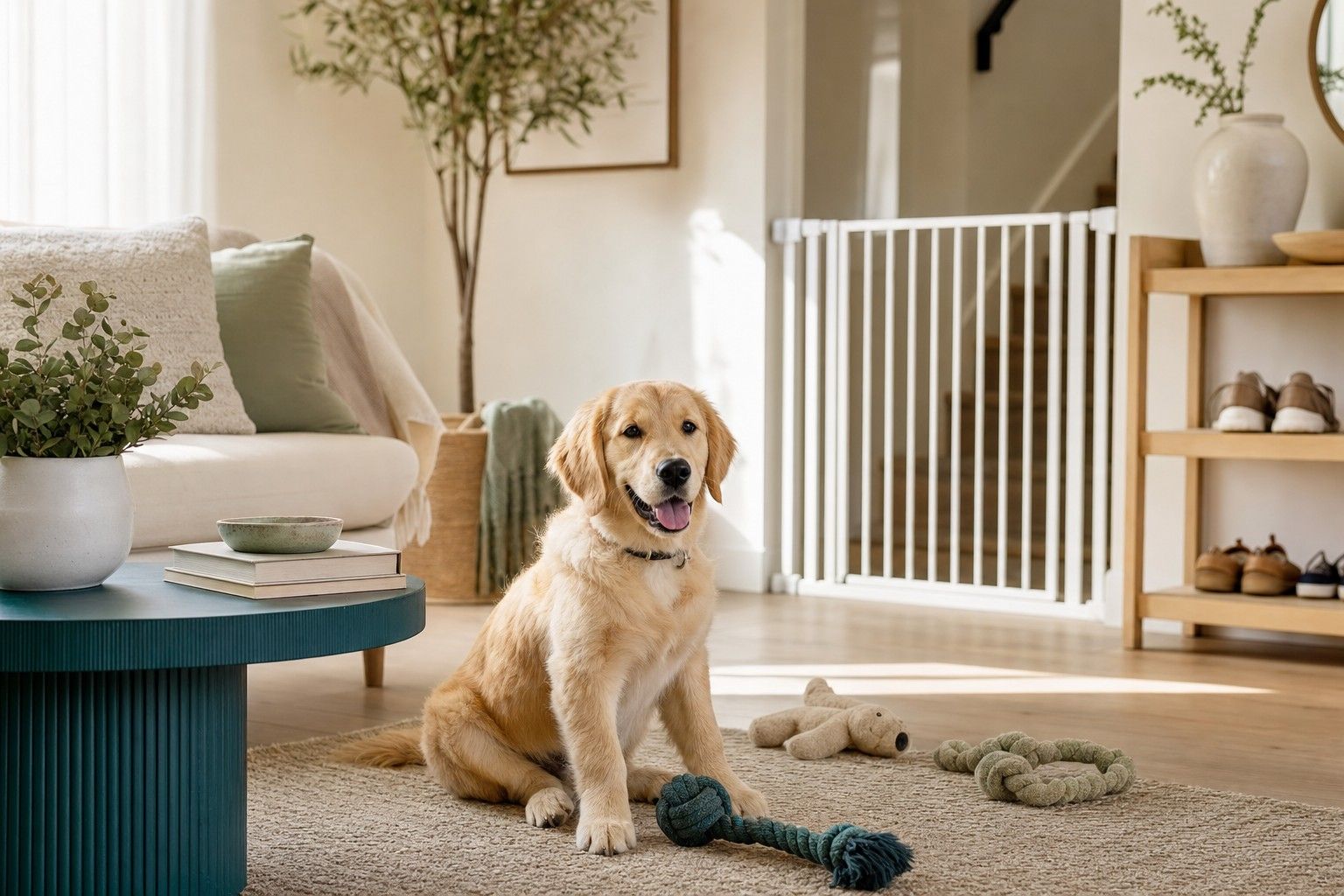
Puppy proofing your house means getting down to puppy height and removing or blocking everything a curious mouth can reach: charging cables, the kitchen trash, toxic foods and plants, shoes, cleaning products and open stairs. Start with the one or two rooms where the puppy will spend its first weeks, gate them off as a safe zone, and open up more of the house as training sticks. If you also have a baby or toddler, most of these fixes protect both of them.
A puppy learns a house with its teeth. For the first month, aim for a small area where nothing dangerous is within reach, so every correction you make is about training instead of a rescue.
Start with a walkthrough at puppy height
Kneel in each room the puppy will use and look along the baseboards. You’ll spot things you never notice standing up: a phone charger looped behind the sofa, the tassels on a rug, a basket of kids’ toys with small parts, the gap beside the refrigerator where a small puppy can wedge itself.
Make two lists as you go. The first is what can simply move, like shoes into a closet, plants onto a high shelf and the laundry basket behind a door. The second is what needs hardware, such as a latch, a gate or a cord cover. The second list is usually shorter, and it’s where most of the work goes.
Puppy proofing your house, room by room
Kitchen and pantry
The kitchen trash is the first thing most puppies raid. Move it into a cabinet with a latch, or switch to a can with a locking lid that a nose can’t flip open. Keep counters clear for the first few months too, because a medium or large puppy learns fast that standing on its back legs pays off.
The ASPCA lists several common foods as dangerous for pets. Keep these off counters and coffee tables and out of reach in the pantry:
- Chocolate, coffee and anything else with caffeine
- Xylitol, a sweetener in sugar-less gum, candy, some baked goods and toothpaste, which the ASPCA says can cause low blood sugar and possible liver damage
- Grapes and raisins, which can lead to kidney damage
- Onions, garlic and chives
- Macadamia nuts
- Alcohol and raw yeast dough
Cleaning supplies under the sink need the same latch you’d use for a toddler. One magnetic or spring latch on that cabinet covers both. Purses and backpacks left on the floor are another easy target, since they often hold gum, medication and snacks.
Living room and home office
Cords are the main hazard here. Route lamp and TV cables behind furniture, run them through split cord covers along the baseboard, and put power strips inside a cord management box. Unplug chargers when nobody is using them, since a phone cable dangling at nose height looks exactly like a toy.
Roll up rugs with fringe or loose threads until the chewing phase passes. Throw blankets, remote controls, crayons and small figurines on a low coffee table are all fair game for a puppy that can reach the tabletop.
Bedrooms, closets and bathrooms
Socks, hair ties, earbuds and underwear are easy for a puppy to swallow, and in a bedroom they all end up on the floor. Keep closet doors shut and laundry in a hamper with a lid. Medication on a nightstand belongs in a drawer or a high cabinet.
In bathrooms, close the toilet lid and use a trash can with a lid, since used floss, razors and cotton swabs end up there. Getting everyone in the house to close the bathroom door does most of the work.
Garage, laundry room and side yard
Car fluids, garden chemicals, pest baits and paint tend to live at floor level in a garage. Move them to high shelves or a locked cabinet before the puppy ever goes in. In the laundry room, keep detergent pods up high and look inside the dryer before you start it.
Walk the side yard and fence line too. Puppies find gaps under gates and between fence boards that an adult dog would ignore.
Toxic plants inside and out
Plants are easy to overlook because they’ve sat in the house for years without a problem. A puppy changes that. Two plants that show up often in Southern California yards and planters are on the ASPCA’s toxic list for dogs:
- Sago palm (Cycas revoluta), which the ASPCA lists as toxic to dogs, cats and horses, with signs that can include vomiting, bruising, liver damage and liver failure
- Oleander (Nerium oleander), which the ASPCA lists as toxic to dogs, with signs that include drooling, abdominal pain and diarrhea
Check every houseplant and yard plant against the ASPCA’s toxic and non-toxic plant database before the puppy has the run of the yard. If a toxic plant can’t come out, fence it off, or keep the puppy on a leash in that part of the yard until you’re sure it ignores plants.
Homes with both a dog and a cat have one more thing to watch. The ASPCA lists true lilies as non-toxic to dogs and toxic to cats, so a bouquet that’s harmless to the puppy can still be dangerous in the same house. Our cat-proofing guide covers that side.
Gates, crates and zones
A new puppy does best with a small territory. Pick a room with an easy-to-clean floor, usually the kitchen or family room, and close it off with gates. Put the crate, water, food and chew toys there. As house training and chewing settle down, open up one more room at a time.
Stairs need a gate at the top and often at the bottom. At the top, use a hardware-mounted gate screwed into the wall or banister, since a pressure gate can be pushed loose by a dog leaning on it. Pressure-mounted gates work well in doorways between rooms on the same floor.
Sizing matters more with dogs than with toddlers:
- For small breeds, check the gap between bars. A toy-breed puppy can slip through spacing a child can’t.
- For large breeds, plan for the adult dog’s height. A gate a puppy respects at 12 weeks may be easy to clear at 8 months.
- For homes with a cat, a gate with a small pass-through door lets the cat reach food and litter while the puppy stays in its zone.
If you’re adding a dog door, decide where it leads before anything is cut. A door that opens onto a pool deck gives a puppy, and a crawling baby who follows it, a direct path to the water. Aim it at a fenced dog run or a side yard that’s closed off from the pool.
Puppy proofing a home that also has a baby
A puppy and a baby can share a house well when each has a space the other can’t reach. The American Academy of Pediatrics (AAP) advises never leaving a small child and a dog alone together, even a dog the family knows and trusts. It also says not to bother a dog while it’s eating or sleeping. In practice, the puppy’s crate and food bowls go behind a gate the baby can’t open, and the nursery door stays shut during naps.
A few overlaps catch parents off guard:
- Dog toys and baby toys look alike. Keep chew toys in the puppy’s zone and teething toys off the floor.
- Dry kibble is small enough for a crawling baby to put in their mouth. Feed the puppy behind a gate and pick up the bowl after meals.
- Diaper pails and bathroom trash attract dogs. Use a pail with a locking lid.
- An excited puppy can knock over a toddler who’s just learning to walk. Gate the puppy during those wobbly first months.
The hardware often does double duty. A hardware-mounted gate at the top of the stairs keeps both a crawling baby and a young puppy off the steps, and the cabinet latches that stop a toddler also stop a curious nose.
Puppy-proofing checklist for the first week
- Trash cans are latched, lidded or behind a cabinet door
- Chocolate, gum, grapes, raisins, onions and macadamia nuts are put away
- Cords run behind furniture or through covers, and chargers are unplugged
- Shoes, socks, hair ties and kids’ small toys are off the floor
- Medication and cleaning supplies are up high or behind a latch
- Houseplants and yard plants are checked against the ASPCA list
- A hardware-mounted gate is installed at the top of every staircase
- The puppy’s zone has a crate, water, chew toys and an easy-to-clean floor
- Toilet lids are down and bathroom doors are closed
- The garage stays off-limits until chemicals are on high shelves
- The fence line is checked for gaps under gates and boards
- The baby and the puppy are never left alone together
When to call a professional
Most puppy proofing is moving things and building habits. Hardware is where a second set of hands helps: gates that have to be mounted into studs or a banister, latches on cabinets you can’t easily see inside, and a dog door that has to go through a wall or slider without rattling or leaking air.
Our pet-proofing visit walks the house with you at dog height and installs the gates, latches and cord management in your plan. If a dog door is part of it, pet door installation puts the door where it gives the dog access without opening a path to the pool. Expecting a baby too? A home safety assessment folds the puppy setup, baby gate installation and cabinet door locks into one itemized plan.