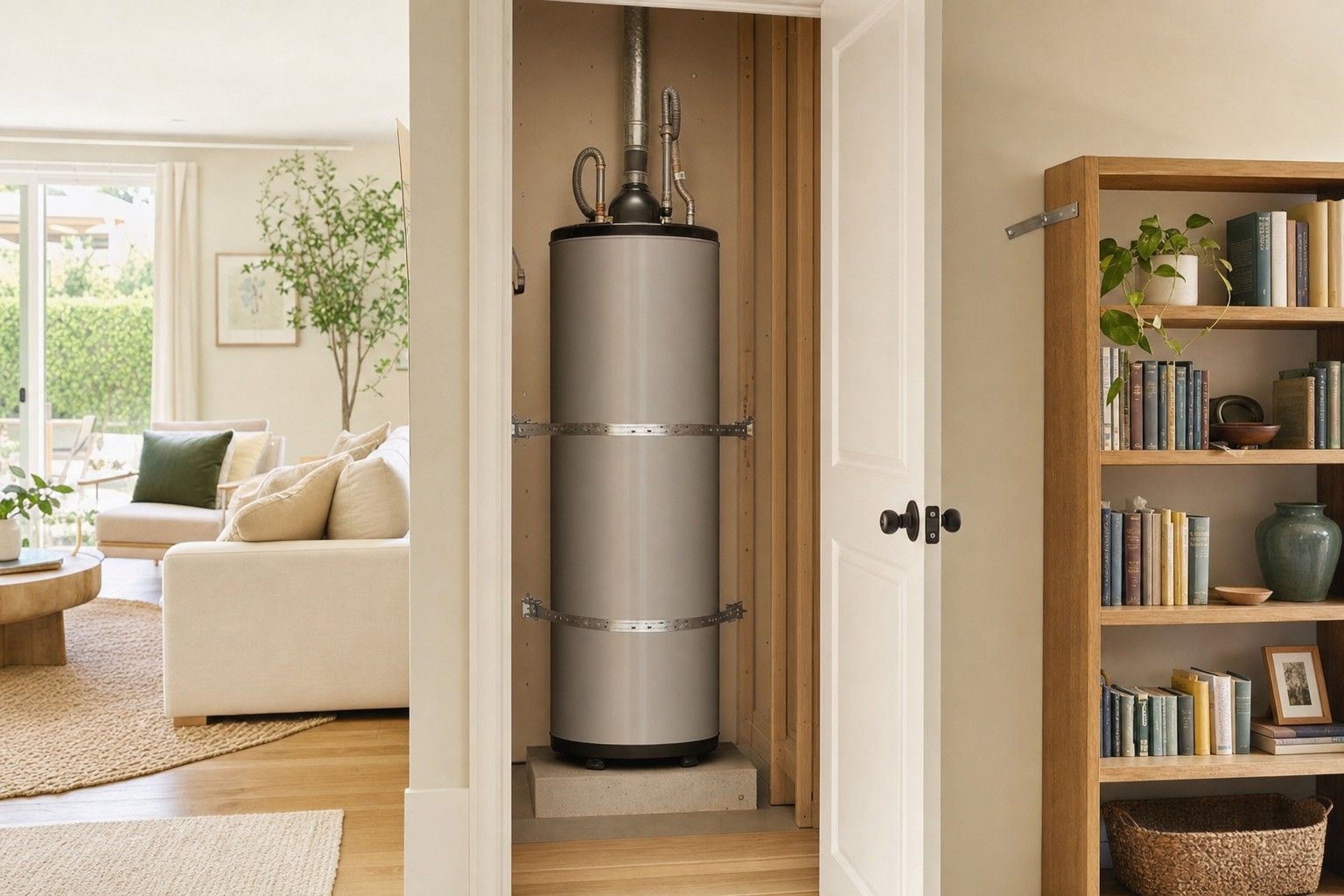
California law requires every residential water heater, whether new, a replacement or already installed, to be braced, anchored or strapped so it can’t fall over or slide sideways in an earthquake. That rule is Health and Safety Code §19211, and it sets the California Plumbing Code as the minimum standard. In the City of Los Angeles, water heater strapping means at least two straps, one in the upper third of the tank and one in the lower third, with the lower strap at least 4 inches above the controls.
What California law says about water heater strapping
Section 19211 sits in the earthquake protection chapter of the Health and Safety Code. Its first subsection says that all new and replacement water heaters, and all existing residential water heaters, must be braced, anchored or strapped to resist falling or horizontal displacement due to earthquake motion. At a minimum, they must be secured in line with the California Plumbing Code or a local version of it adopted by a city or county. The section also covers a few situations homeowners run into:
- Selling a home. The seller of any real property with a water heater must certify in writing to the buyer that the heater meets the law. That statement can go in existing transaction documents, such as the purchase contract or the transfer disclosure statement.
- Renting. An owner of a residential rental property may not evict anyone on the grounds that the eviction is needed to comply with the strapping rule.
- Which heaters count. The law defines a water heater as any standard unit of 120 gallons or less for which a pre-engineered strapping kit is readily available.
- Nuisance status. A building that violates the strapping rule is deemed a nuisance, and the owner has the right to correct it.
The article on water heater strapping was added to the code in 1989, and the current text of §19211 dates from a 2003 amendment that took effect on January 1, 2004. Older straps installed under earlier rules may not match today’s local requirements.
How the two-strap standard works in Los Angeles
The state law points to the Plumbing Code, and cities can modify it, so the exact details depend on where you live. In the City of Los Angeles, the Department of Building and Safety (LADBS) publishes an information bulletin titled How to Brace Your Water Heater. The current version took effect January 1, 2026, references section 507.2 of the Los Angeles Plumbing Code, and spells out the requirements. According to that bulletin:
- Water heaters must be strapped in at least two locations, the upper one-third of the unit and the lower one-third.
- The lower strap must sit at least 4 inches above the water heater control unit.
- Straps are anchored to the wall with lag screws at least 1/4 inch in diameter, each with at least 1-1/2 inches of thread penetration into a wall stud.
- A large flat washer goes between each lag screw and the strap.
- Its example installation uses metal strap at least 22 gauge thick and 3/4 inch wide, with pilot holes drilled on the centerline of the stud on both sides of the heater.
- Perforated metal strap, known as plumber’s tape, is not acceptable for water heaters over 40 gallons.
- Against a concrete or masonry wall, the bulletin’s detail shows 1/4-inch expansion anchors with at least 2 inches of embedment.
The bulletin also notes that the wall clearances listed on the unit’s nameplate are critical, and that an over-the-counter water heater restraint kit approved by the state can be used. Its drawings show flexible water and gas connections at the top and bottom of the tank, and a spacer between the tank and the wall where needed.
The two-strap approach is the common practice statewide. The Earthquake Country Alliance’s Seven Steps to Earthquake Safety tell homeowners to secure the water heater to wall studs with two metal straps. If you live outside the City of Los Angeles, check your own city’s building department for any local changes.
Checklist: is your water heater strapped correctly?
You can check your own straps with a flashlight and a tape measure. Look for each of these:
- Two straps, one in the upper third of the tank and one in the lower third.
- At least 4 inches between the lower strap and the gas control or thermostat.
- Straps wrapped around the tank and fastened into wall studs or masonry, not just drywall.
- Lag screws with large flat washers at each fastening point.
- Solid metal strap, not plumber’s tape, if the tank holds more than 40 gallons.
- A spacer or blocking between the tank and wall if there’s a gap, so the tank can’t swing back.
- Flexible connectors on the water lines and the gas line.
- A tank that doesn’t rock or shift when you push it firmly at the top.
- Clear access to the controls, the gas shutoff valve and the vent.
If anything on the list is missing, the straps may not hold in a strong quake. A heater that tips or slides also pulls on its gas and water lines, so the connections matter as much as the straps.
When you need a plumber
Strapping itself is a hardware job. The work around the gas line, the water lines and the vent is different, and some of it needs a plumber and a permit. Call a plumber when:
- The gas line runs to the heater in rigid pipe with no flexible connector, or the connector looks old, kinked or corroded.
- The water lines are rigid, or the heater needs to move to make room for straps.
- The vent pipe is loose, disconnected or damaged.
- The tank leaks, shows rust at the base, or the relief valve drips.
- You are replacing the water heater. In the City of Los Angeles, LADBS says replacing a gas water heater in a single-family home requires a plumbing permit, unless a contractor with a valid LADBS Certificate of Registration does the work.
The order matters. If the connectors need work, have the plumber handle that first, then install or upgrade the straps once the heater is in its final position.
While you’re at the water heater
This is a good moment to handle the childproofing side too. The U.S. Consumer Product Safety Commission (CPSC) recommends setting water heaters to 120°F or lower to help prevent scalds, and suggests anti-scald devices on faucets and shower heads. Check the dial on the tank while you have the flashlight out.
Look at where the heater lives. If it sits in a laundry room, a hall closet or a garage your toddler can reach, keep that door latched. The gas valve, the burner access panel and the hot pipes are not things a curious two-year-old should be able to touch.
Water heaters in Los Angeles homes
In older Los Angeles houses, water heaters are often in the garage, in an exterior closet built against the house, or in a utility room. Some newer and remodeled homes put them in attics or interior closets. Each location changes the strapping, since the straps need studs or masonry on the right sides of the tank.
Many older installations still have a single band of plumber’s tape from years ago. Hillside homes may have heaters in tight closets on a lower level where finding studs takes care. If you are buying or selling, the strapping certification in §19211 makes it worth checking before escrow, and our page for designers and realtors explains how we work with agents.
When to call a professional
If the gas and water connections are in good shape and you just need proper straps, that is the kind of work our earthquake safety service covers, along with cabinet latches and furniture anchors in the same visit. If the connectors or the vent need attention, we’ll tell you so a plumber can handle that part.
For the rest of the house, see our guides on anchoring furniture and TVs and earthquake-proofing a home with kids. A home safety assessment includes the water heater in your itemized plan.
Sources
- California Health and Safety Code Section 19211, California Legislative Information
- How to Brace Your Water Heater, Information Bulletin P/PC 2026-003, Los Angeles Department of Building and Safety
- Is a plumbing permit required to replace my gas water heater in my single family dwelling unit?, Los Angeles Department of Building and Safety
- Step 1: Secure Your Space, Earthquake Country Alliance
- Childproofing Your Home: Several Safety Devices to Help Protect Your Children from Home Hazards, U.S. Consumer Product Safety Commission