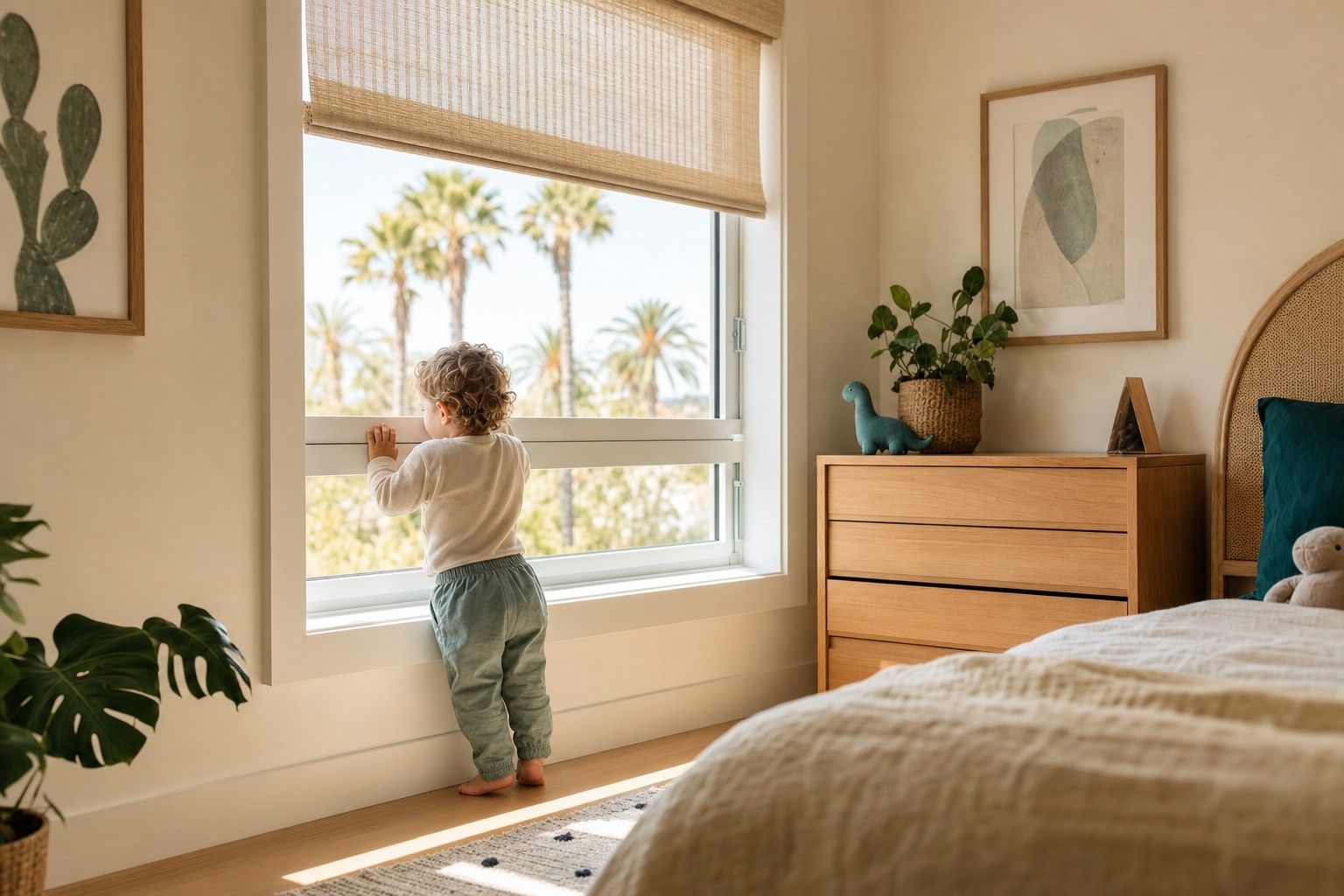
Window stops limit how far a window opens, usually to 4 inches, so a child can’t fit through the gap, while window guards are bars or grilles that cover the opening. The U.S. Consumer Product Safety Commission (CPSC) recommends installing window stops so windows open no more than four inches, and on windows at the 6th floor and below, using guards that adults and older children can open easily in a fire. Screens keep insects out, and the CPSC says never to rely on them to stop a fall.
Window stops are often sold as window safety locks. Which device fits depends on the window type, the floor it’s on and whether it’s a bedroom’s escape route. Blind cords are a separate hazard at the same windows, and cordless coverings take care of it.
Why window falls happen
Window falls cluster in the warm months, when windows are open for air. In an April 2026 release, the CPSC estimated that 5,600 children 12 and younger were treated in emergency departments in 2024 after falling out of a window, and that about one in three of them were hospitalized. The CPSC is aware of at least 25 deaths among children 12 and under from window falls between 2021 and 2023, and 80 percent of those happened between May and October.
Los Angeles has a long open-window season, and the housing adds its own risks. Two-story homes often put bedroom windows over a concrete patio or driveway. On hillside lots, a second-floor window on the downhill side can sit a full story higher off the ground than it looks from inside. Window seats, beds and toy chests put a climbing toddler right at sill height.
The CPSC’s advice starts with the room: keep furniture away from windows so children can’t climb up to them, and when the window allows it, open it from the top instead of the bottom.
Window stops versus window guards
Window stops and window safety locks
A window stop is a small device that limits how far a window slides or swings open. On single-hung and double-hung windows, it mounts in the side track above the lower sash. On horizontal sliders, it clamps or screws into the track. Casement and awning windows use a limiter, often a short cable or arm, that catches the window a few inches open.
Stops suit most two-story houses. They’re small, they don’t change how the window looks from the street, and an adult can release them to open the window fully. Look for stops that hold the opening to 4 inches or less and release with an adult action a small child can’t copy, such as pressing two buttons at once. On bedroom windows, pick a stop that releases by hand without a key or tool.
Window guards
A window guard is a set of bars across the lower part of the opening. The CPSC’s childproofing guidance says to limit window openings to four inches or less, including the space between window guard bars. Guards fit windows that need to open wide for air, high-rise units, and windows where the frame won’t take a stop.
For windows on the 6th floor and below, the CPSC recommends guards that adults and older children can open easily in case of fire. A guard that’s screwed shut with no release turns a bedroom window into a wall.
Choosing between them
- Use stops on windows a child can reach that you mostly open a few inches for air.
- Use guards on windows that need a wide opening, or where the frame won’t hold a stop.
- On bedroom windows, make sure either device has a quick release an adult can work by hand in the dark.
- Pair either one with moving furniture away from the window.
Why screens don’t stop falls
A screen is a lightweight frame held in place by small clips or springs. It’s built to keep insects out, and a toddler leaning on one, or pushing on it to see outside, can pop it out of the frame. The CPSC’s April 2026 release says to never depend on screens to keep children from falling out of windows, and its childproofing guide says window screens are not effective for preventing children from falling.
Keep screens for insects, and add a stop or a guard for the child.
Bedroom windows must still work as escape routes
Every bedroom needs a way out in a fire, and a window safety device can’t take that away. The 2025 California Residential Code requires every sleeping room to have at least one operable emergency escape and rescue opening, and that opening has to work from inside the room without keys, tools or special knowledge. The code allows window opening control devices and fall prevention devices that comply with ASTM F2090 on those windows, as long as the release mechanism stays operable at all times. Once the device is released, it can’t shrink the window’s clear opening below the size the code requires.
The same code also requires fall protection on some windows in homes built under it. Where the bottom of an operable window opening is less than 24 inches above the floor and more than 72 inches above the ground outside, the window either can’t open wide enough to pass a 4-inch sphere or has an ASTM F2090 device. Older homes can use the same numbers as a benchmark.
The CPSC’s childproofing guide makes the same point about guards, advising that at least one window in each room can be easily used for escape in a fire. At home, that means:
- Choosing stops and guards with a release an adult can operate by hand in a few seconds
- Never screwing a bedroom’s escape window permanently shut or blocking it with a fixed bar
- Showing older children, sitters and grandparents how the release works, and adding it to your fire escape plan
- Keeping the path clear, since a crib or dresser in front of the escape window blocks the way out
Window blind cords
Corded blinds and shades are a separate window hazard, because a child can get a cord around the neck. The CPSC estimates that, on average, about nine children under 5 die each year from strangling in window covering cords. From January 2009 through December 2021, the agency counted more than 200 incidents involving children up to 8 years old, and a child died in 48 percent of them.
The CPSC says cordless window blinds, shades, draperies and other window coverings are the safest option, and it recommends them in all rooms where a child may be. Under a CPSC rule, stock window coverings (ready-made products sold off the shelf) that fail the operating cord requirements of the ANSI/WCMA A100.1-2018 standard are deemed a substantial product hazard. Custom window coverings aren’t subject to those operating cord requirements, so when you order made-to-measure shades, ask for a cordless or motorized version by name.
If corded coverings have to stay for now, the CPSC suggests:
- Shortening pull cords as much as possible so nothing dangles
- Keeping all window covering cords out of children’s reach
- Installing cord stops and adjusting them to limit inner lift cord movement
- Anchoring continuous-loop cords for draperies and blinds to the floor or wall
- Moving cribs, beds, furniture and toys away from windows and cords, preferably to another wall
Window safety for kids: a home checklist
- Every window a child can reach has a stop set to 4 inches or less, or a guard
- Bedroom escape windows have devices that release by hand, without a key or tool
- Cribs, beds, dressers and toy chests sit away from windows
- Nobody counts on a screen to keep a child in
- Windows open from the top when the design allows it
- Window coverings are cordless, or cords are shortened, out of reach and anchored
- Older kids, sitters and grandparents know how to open the escape window
- Stops and guards get checked each spring, before the warm months
When to call a professional
Window hardware is specific to the window. Vinyl sliders, older aluminum frames, wood double-hungs in a Craftsman and steel casements in a Spanish Revival home each take a different stop, and a stop mounted in the wrong spot can crack a frame or slip under a push.
Our window safety service fits stops, limiters and guards to each window, with releases that keep bedroom windows usable for escape. A home safety assessment covers windows along with the rest of the house, including dressers and bookcases near sills that should be moved or anchored to the wall. If a cat shares the house, our cat-proofing guide covers screens and balconies, and the childproofing checklist covers every other room.
Sources
- CPSC: CPSC Urges Families to Protect Children During National Window Safety Week (April 2026)
- CPSC: Childproofing Your Home
- ICC: 2025 California Residential Code, Chapter 3, Building Planning
- CPSC: Nearly Half of Incidents with Kids and Corded Window Coverings Resulted in Death
- CPSC: Window Coverings 15(j) Rule FAQs